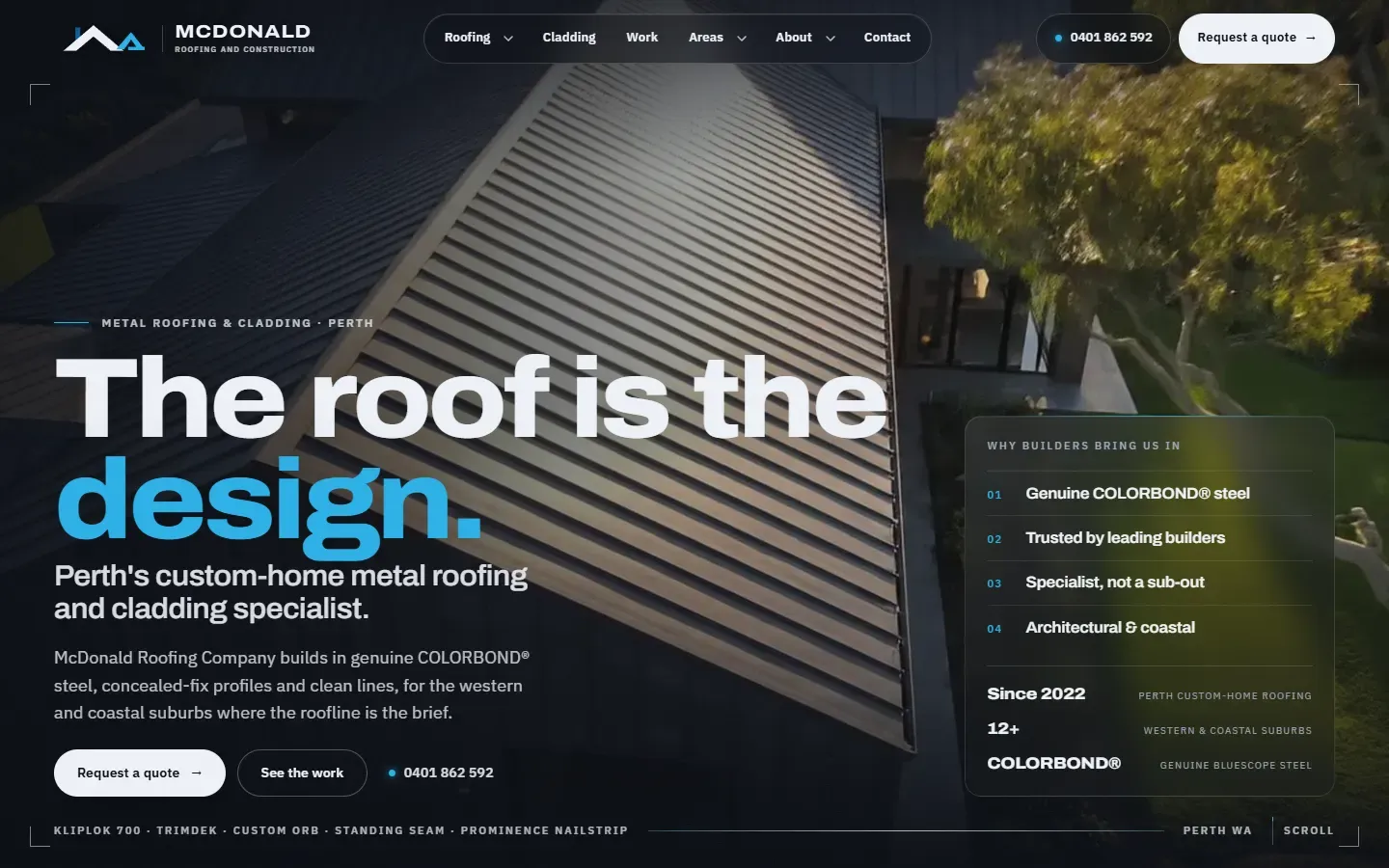
A hero photo, a service list and a contact form describe the visible shell of a tradie website. The useful questions sit underneath the design: whether the pages match the real business, whether a customer can take the next step, whether search engines can read consistent facts, and whether enquiries can be measured.
If you want a website built rather than a how-to, start with web design in Perth or the trade pages for pool service, render and plaster, roofing, electrical, greengrocers, plumbing, carpentry and tiling.
Do tradies need a website?
Yes, if the business wants work from people who have not already been referred to it. The website is where the Google Business Profile, directory listings and social pages send people, and it is the one place the business controls that can answer service and suburb searches in its own words.
A tradie booked out on referrals alone can start with the free Google Business Profile and add a site later. What a build costs, from Kovus and across the market, is on pricing, and the DIY route is compared in Wix vs a professional website for tradies.
Start with the business’s own baseline
Before setting a target, record what is true now:
- the services and locations the business genuinely covers
- the current pages, search queries and Google Business Profile state
- the calls or forms the business can attribute to the website
- the mobile performance, accessibility and technical search checks at launch
Those client-specific figures make a useful baseline. Market statistics do not establish what one site will convert, rank for or earn.
The problem: a digital business card leaves key questions unanswered
A business card tells someone who already has your number what you do. A useful website also explains the services, shows verified proof, helps a customer make contact and gives the business a way to measure what happened next.
Five areas to consider in a trade website scope
A useful trade website scope covers five connected areas: pages for the services and locations the business really covers, a clear mobile enquiry path, consistent machine-readable business facts, content built from real customer questions, and tracking tied to agreed enquiry events. None of them guarantees a ranking or an enquiry on its own.
Three shipped Kovus builds show how the mix changes with the business. The Fruit Basket, an independent greengrocer in Mount Pleasant, has 18 delivery-area pages, each with its own distance, cut-off time and local FAQ, and Search Console and web analytics were connected from launch. McDonald Roofing Company in Wangara has 12 service-area pages grouped into three real Perth regions, backed by named-builder trust and a 19-photo project portfolio. CJH Concrete started with no website and no Google Business Profile, and its build has 16 service-area pages across the northern corridor plus eight finish-led service pages. So the greengrocer leans on delivery pages, the roofer on project proof and the concreter on finish pages. Each of these sites is live, and each business owns its site, content and domain. The case studies cover what shipped in each build.
01. The Local SEO Engine
Use individually scoped pages for the services and locations the business genuinely covers, rather than one generic service-areas list or a batch of city-swapped pages. Local facts, photos and reviews belong on a page only when they are verified. The Google Business Profile work should match the same business information and the access included in the scope.
02. The Enquiry Path
Use tap-to-call, short forms, useful pricing information where the client approves it, and verified licensing, insurance, warranty or trade credentials where relevant. Record mobile performance and accessibility checks before launch. Measure enquiry events against the client’s baseline instead of assigning a fixed conversion rate.
03. AI Search Visibility
Use consistent verified descriptions across the website and the profiles included in the client scope, plus relevant structured data. An AI product may still choose not to include, cite or recommend the business, so mentions are monitored as an outside result, not promised.
04. The Content Hub
Publish useful answers to questions real customers ask, such as roofing project proof, pool care or rendering options. Each guide should be fact-checked, linked to the relevant commercial page and assigned an approval and publishing cadence in the client scope. Traffic and enquiries are measured after publication, not promised beforehand.
05. The Tracking Layer
Track the enquiry events agreed with the client and connect them to the available page and source data. Search Console, local visibility and AI-mention checks can be included where useful. Reporting should separate work delivered from rankings, traffic and enquiries observed.
What it actually means for the business
The five areas support each other, but they do not create an automatic result. The website and content are deliverables. Rankings, traffic, calls and AI mentions are measured outcomes that depend on the starting point, the market and external platforms.
Explore by trade
The skeleton above is constant. The fit-out changes per trade:
- Pool service: service and location pages, a clear urgent-service path and verified pool-care proof
- Render & plaster: finish-specific service pages, applicator-certification trust, and a project gallery that sells the craft
- Roofing & restoration: project evidence, verified product and warranty details, and a clear quote path
- Electrical: verified licence and compliance information, service details and plain cost guides
- Greengrocers: a produce-led site and ordering or fulfilment information matched to how the shop actually trades. See the greengrocer website field guide and the live Fruit Basket Perth build.
- Plumbing: a page per job type, the call-out fee on the first screen and the right licence for each job
- Carpentry: labelled project photos of decks, kitchens and built-ins, and a quote form that can qualify the job
- Tiling: waterproofing documented to AS 3740, separate pages for bathrooms, floors and splashbacks, and a quote form that asks for the m2 and the format
- Painting: separate pages for homeowners and builders, with labelled photos of finished jobs
Field guides, by topic
- Roofing website design examples
- Plumber website design examples
- Greengrocer website produce and ordering
- Tiling website project proof and waterproofing
- Carpentry website project proof and scope
- Painter website pages, photos and proof
- Marketing for tradies: what to do first
- Marketing for plumbers in Australia: what to do first
- Is hipages worth it, and the alternatives
- Google Business Profile suspended: how to appeal
- Google Business Profile verification: video and postcard
- How to get a fake Google review removed
- Someone else owns your Google Business Profile
- Licence numbers on WA tradie websites
- Wix vs a professional website for tradies
- AI search for local businesses in Australia
- Google review request templates for tradies
- Service pages vs suburb pages for tradies
See the proof and the pricing
The Kovus homepage, websites for tradies, sets out what Kovus builds, what it costs and who owns it. The case studies write up client builds, including The Fruit Basket Perth and McDonald Roofing Company. For a WA business, the local page is web design in Perth.
The practical website and search guides are collected under resources. The pricing page explains the one-off build, the written scope and the optional month-to-month services, and what tradie websites cost across the Australian market.
Want the honest version for your business?
Tell me your trade, services and real service area. I’ll outline the pages, enquiry path and measurement that would make sense for your operation, with no fixed ranking or outcome promise.
Frequently asked questions
What separates a useful tradie website from a template one?
Five connected areas: useful pages for real services and locations, a clear mobile enquiry path, consistent machine-readable business facts, content based on customer questions, and tracking tied to agreed enquiry events. None guarantees a ranking or enquiry result on its own.
Do I need all five systems, or can I start with one or two?
Start with a usable website, a clear enquiry path and sound technical foundations. Content, Google Business Profile work and ongoing monitoring can then be scoped to the business. The quote should list what ships now and what remains optional.
How is a trade website different to a normal small business website?
Trade searches are often local and time-sensitive. A customer searching '[suburb] electrician' or 'emergency roof leak' needs verified licensing where relevant, useful service information and a phone number they can tap, not just a generic about page.
Does this apply to every trade the same way, or does it change per niche?
The technical skeleton is repeatable, but the fit-out changes. Roofing may need project evidence and verified warranty information. Electrical may need licence and compliance details. Pool service, rendering, carpentry, tiling and local retail each need their own services, proof and customer journey.
Will this work for a business with only one truck and one suburb?
Yes. A single-area operator needs useful pages for the services and locations it genuinely covers, not a batch of thin location pages. The build is quoted to the agreed scope.
Where do I start if I want to see how this looks for my own trade?
Read the field guide for your trade, or start with the cost and DIY-vs-professional guides. Then compare the suggested deliverables with your actual services, locations, proof and current website data.