In Western Australia, electrical contractors, plumbing contractors, building contractors and painting contractors each have a written rule that puts their licence or registration number in their advertising. Building and Energy’s guidance for electricians, builders and painters names web pages among those advertisements. For a trade website, that makes the number part of the page, the same as the phone number and the ABN.
This guide sets out which number each trade shows, how to write it, and where it goes on a website so a customer who checks finds the same number everywhere. Each rule is linked to its source, and the regulator’s own pages are the place to confirm what applies to your business today.
General information, not legal advice
This guide is about what to show on a website. Check the current requirements with Building and Energy (1300 489 099) or your own adviser before you publish.
Which WA trades must show a licence number in their advertising?
Four trades have a rule that names the number. An electrical contractor shows its licence number conspicuously in any advertisement for its electrical contracting business. A plumbing contractor shows its licence number in any advertisement relating to the business, and on business documents such as written quotes and invoices. A registered building contractor or painting contractor shows its registration number in any advertisement about being available for that work. Gas fitters advertise only the gas credentials they hold.
| Trade | Where the rule sits | What to show | Where it goes on the site |
|---|---|---|---|
| Electrical contractors | Electricity (Licensing) Regulations 1991, reg 45(1), with Building and Energy's guideline | The electrical contractor's licence number, EC and the digits, displayed conspicuously | Header beside the phone number, footer, contact page, structured data, and the van and business cards |
| Plumbing contractors and restricted permit holders | Plumbers Licensing and Plumbing Standards Regulations 2000, regs 25 and 25A | The licence or permit number in advertising and on business documents, including written quotes, receipts and invoices | Header, footer and contact page, plus every quote, receipt and invoice template |
| Building contractors | Building Services (Registration) Act 2011, s 8 | The registration number from the contractor's certificate, in advertising for builder work | Header, footer, the pages for builder work and the structured data |
| Painting contractors | Building Services (Registration) Act 2011, s 8 | The registration number from the contractor's certificate, in advertising for painter work | Header, footer, the painting service pages and the structured data |
| Gas fitters | Gas Standards (Gasfitting and Consumer Gas Installations) Regulations 1999, reg 38(1) | Only the gas certificates, permits and authorisations the business holds, named as issued | The gas service pages, beside the work each credential covers |
Every source is listed at the end of this guide, with a link to the legislation and to Building and Energy’s pages.
A roofing, tiling, carpentry or concreting business that holds a building contractor registration because it takes on builder work is a building service contractor for that work. Its advertising for builder work carries the registration number in the same way, so the pages for that work are where the number belongs.
Why the number belongs on the website
For electrical contractors, builders and painters, Building and Energy says in writing that websites count. Its guideline for electrical contractors lists “web pages” among the things it treats as advertisements, and its pages for registered builders and painters name “website advertisements”. The plumbing regulations say an advertisement includes a business card or letterhead, and a plumbing website does the same job as both, so treat it the same way.
There is a plain business reason too. A customer about to let someone into their switchboard, their gas line or their roof space may well check the licence first. A number in the header, written as text, can be copied straight into Building and Energy’s licence search. A customer who finds it in one step has one less reason to call someone else.
The electrical guideline also covers listings. It counts “solicited and authorised entries in Yellow Pages, Big Colour Pages and community directories” as advertisements, and says a contractor has not breached the regulation when a Yellow Pages advertisement or listing was placed without their authorisation, acknowledgment or consent. So the listings you set up yourself carry the number, the same as the site.
Electrical contractors: regulation 45(1)
The rule sits in the Electricity (Licensing) Regulations 1991, in the part that licenses electrical contractors. It says the holder of a licence must ensure that “the number of his or her licence is conspicuously displayed in any advertisement advertising his or her electrical contracting business.”
The number that goes on the site is the electrical contractor’s licence, the one that starts with EC. An electrical worker’s licence, held by the person on the tools, is a different licence. A site that shows the worker’s licence in the header, or mixes the two, leaves a careful customer unsure which business they are dealing with.
Building and Energy publishes a short guideline on how the number should look. It is linked from the WA Government’s electrical contractor’s licence page.
The same guideline says three more things worth knowing before you design anything:
- Where it goes. “The number must be associated with the main body of the advertisement.” On a vehicle, every advertisement, front, back or sides, carries the number.
- What counts. An advertisement is “a public announcement designed to attract attention or bring in custom”, including web pages, business cards, signage on vehicles and buildings, and letterheads. Identification on small tools owned by the business does not count.
- Who issues it. The Electrical Licensing Board issues the licence, not Western Power or Building and Energy. The guideline adds: “There should not be any reference to these organisations in relation to the number”.
The WA Government’s electrical licensing page puts it in one line: contractors “must display their licence number (starting with ‘EC’) on all business materials like ads, vehicles, and business cards.”
For the website, that means the EC number in the header on every page, at a size a customer can read without zooming, and no Western Power or Building and Energy logo beside it.
Plumbing contractors: regulations 25 and 25A
The plumbing rules are in the Plumbers Licensing and Plumbing Standards Regulations 2000, and they cover two things: advertising, and the documents you send customers. A licensed plumbing contractor or permit holder “must ensure that the number of the licence or permit appears in any advertisement relating to the business”, and the regulations say an advertisement includes a business card or letterhead. A permit holder is the holder of a restricted plumbing permit.
The same rule reaches the paperwork. A licensed plumbing contractor or permit holder “must ensure that the number of the licence or permit appears in any business document relating to the business”, and the regulations list what a business document includes.
Business documents in regulation 25A(2)
- A business letter
- A statement of account
- A receipt
- A written quotation of a price for goods or services
- A written offer to contract for goods or services
- An invoice
So the emailed quote, the PDF invoice and the receipt all carry the number. If they come out of job management software, the number goes into the template once and every document carries it from then on.
The regulations also stop anyone representing that they hold a licence or permit they don’t, or that they are authorised for plumbing work of a kind they are not. For the website, that means the service pages list the plumbing work the licence covers. Gas work sits on its own pages, under its own credential, as the gas section below explains.
Builders and painters: section 8
Builders and painters register under the Building Services (Registration) Act 2011. Section 8 says a building service contractor “must cause the contractor’s registration number to appear in any advertisement published by the contractor in respect of availability of the contractor to carry out prescribed building services.” The registration number is the one on the contractor’s certificate of registration.
The Building Services (Registration) Regulations 2011 set out which work is a prescribed building service. The two that matter to trades are builder work and painter work.
Builder work, regulation 13
Building work that needs a building permit
- Valued at A$20,000 or more, or A$50,000 or more for a Class 10a building.
- Carried out in an area of the State set out in Schedule 3.
- Not including listed work such as building a farm building, installing timber decking, cabinet making and installation, or joinery (2nd fixing) work.
Painter work, regulation 28
Painting work done for payment or reward
- Valued at A$1,000 or more.
- Carried out in an area of the State set out in Schedule 4.
- Both schedules start with the South West Division described in the Land Administration Act 1997, then add named districts or townsites.
Building and Energy’s pages for registered builders and registered painters and decorators say that section 8 “requires builders, painters, and building surveyors to include their registration number in advertisements such as newspaper, radio, television, or website advertisements.” Both pages are the place to confirm the current rules for your registration.
Signs on site are a separate requirement from advertising. Building and Energy’s pages cover the site sign too: the contractor’s name and registration number, a contact phone number, and the name and registration number of the nominated supervisor. If the website shows photos of a current job, a sign in the shot that matches the number in the header is a small detail customers notice.
One practical point from Building and Energy’s licence and registration search page: “Registered practitioners and contractors may have the same registration number.” The website carries the contractor’s registration number, so check the name, the number and the licence type on the register before it goes on the site.
Gas fitters: show the credentials you hold
Gas work in WA is covered by the Gas Standards (Gasfitting and Consumer Gas Installations) Regulations 1999, made under the Gas Standards Act 1972. The advertising rule in the regulations is about honesty: a person who is not the holder of a certificate of competency, a permit or an authorisation to do gasfitting work, or a particular class of it, “must not advertise or otherwise represent that the person is the holder of that certificate of competency, permit or authorisation.”
For a website, that means naming each gas credential exactly as it is issued, on the pages for the work it covers. A gas hot water page sits under the gas credential. A blocked drain page sits under the plumbing licence. Many gas fitters also hold a plumbing contractor’s licence, and for that business the plumbing rule above puts the licence number in its advertising.
Where to put the number on your website
This is how I place a licence or registration number on the sites I build, so that a customer who checks finds it quickly and finds the same number everywhere.
- In the header, beside the phone numberThe header is on every page, so every page that advertises the business carries the number. For electrical contractors, Building and Energy's guideline wants it with the main body of the advertisement, not hidden away.
- In the footer, with the business name and ABNThe footer is where people look for the fine print. Write the licence type out in full there: WA electrical contractor's licence, plumbing contractor's licence, or building or painting contractor registration.
- On the contact and about pagesThese are the pages a careful customer reads before ringing. Put the number next to the person who holds it, with a link to Building and Energy's licence search.
- On quote and invoice PDFsFor plumbing contractors, the regulations name written quotations, receipts and invoices. For every trade, the quote is the document a customer compares.
- On your Google Business Profile and listingsWhere a listing has room for it, such as a business description, write the number exactly as it reads on the site. For electrical contractors, the guideline counts authorised directory entries as advertisements.
- In the structured dataLocalBusiness markup can carry the licence as a credential, so search engines read the same number as the customer. The Probuild example below shows the markup.
- As text, at a readable sizeText can be read by a screen reader, copied into the licence search and read by search engines. A photo of a licence card can't. Electrical contractors have the guideline's 50% figure to measure against.
Write the number the way the licence writes it. For an electrical contractor that is EC and the number, with Lic. No. in front if you like. For a builder or painter, use the registration number from the contractor’s certificate of registration. Keep it in one place in the site’s code, so the header, footer, contact page and structured data change together when it does.
How often the number shows in practice: in the Perth tradie website study, 66 of 80 Perth and WA electrician homepages (83%) showed an EC number and 42 of 53 plumber homepages (79%) showed a PL number, as text or in an image, when I checked them by hand in October 2026. A number inside an image is one a customer can’t copy and a search engine may not read, so text is the safer choice.
An example: how Probuild shows its NSW licence
Probuild Construction Co is a Kovus client in Cessnock, New South Wales, where builders hold a NSW contractor licence rather than a WA registration. The placement works the same way in any state, so its site is a working example of a licence number shown where a customer looks. Its NSW contractor licence, 459690C, was checked as current on the public Verify NSW register before launch, then published on the page and in the structured data.
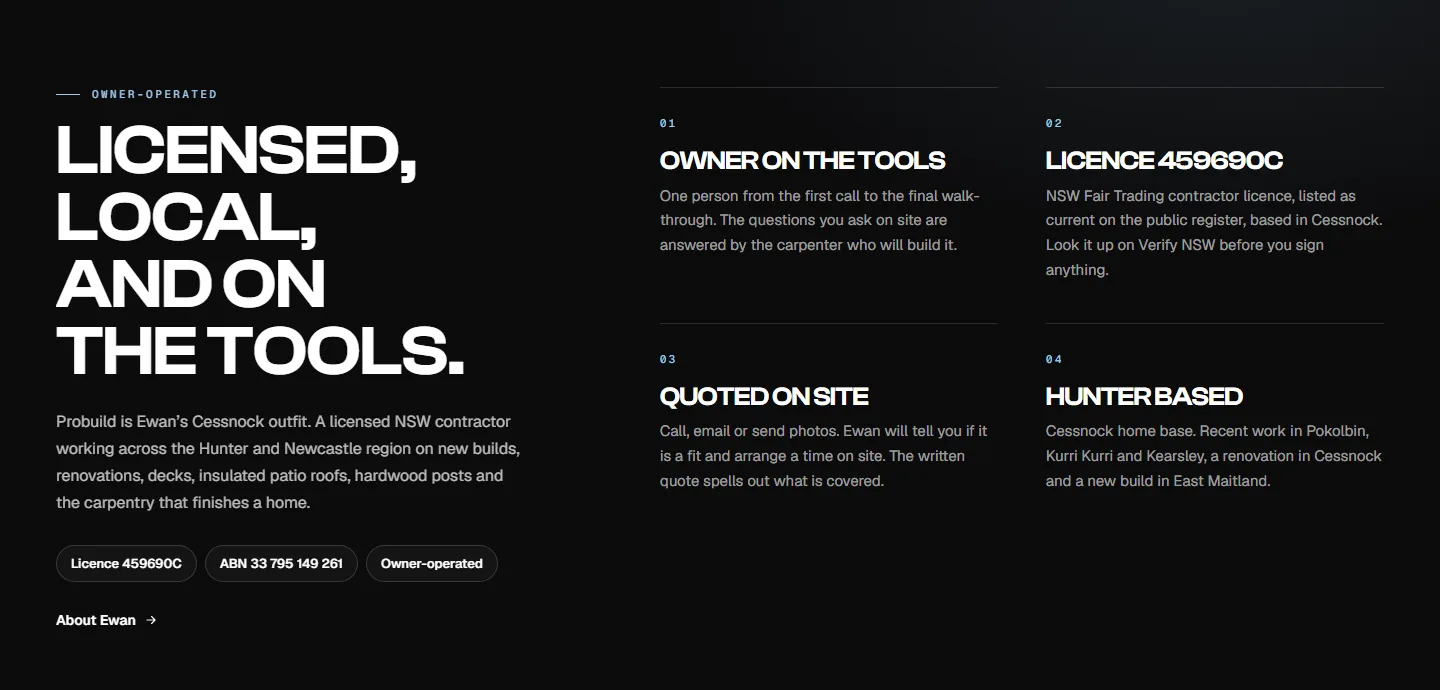
On the homepage, the number appears in the menu, in the hero, in a short list of key facts, in the trust section in the screenshot, in the answer to “Are you licensed?”, in the footer beside the service area, in the meta description and in the structured data. The first credential in the structured data names the licence and the body that issues it:
"hasCredential": [{
  "@type": "EducationalOccupationalCredential",
  "credentialCategory": "license",
  "name": "NSW Contractor Licence 459690C",
  "recognizedBy": { "@type": "Organization", "name": "NSW Fair Trading" }
}]
For a WA electrical contractor, the same block would carry EC and the number, and name the Electrical Licensing Board, which Building and Energy’s guideline says issues the licence.
When the number changes or lapses
Licences get renewed, businesses change names and contractors move premises. Each of those can change what the site should say, and the regulations expect the advertising to keep up. WA’s plumbing regulations, for example, ask a licensee whose licence or permit has expired to remove references to it from advertisements and business documents where practicable, and the electrical regulations ask an electrical contractor to tell the Electrical Licensing Board when its business name, trading name or principal place of business changes.
Update the site in the same week as anything changes on the licence, so the site, the Google profile and the register agree. A number kept in one place in the code makes that a single edit, and the quote and invoice templates are the next thing to check.
Sources
The WA legislation and Building and Energy’s own pages, each linked. Confirm the current version with Building and Energy before you publish.
Electricity (Licensing) Regulations 1991
The electrical contractor's licence number in advertising.
Plumbers Licensing and Plumbing Standards Regulations 2000
The licence or permit number in advertising and on business documents.
Building Services (Registration) Act 2011
The registration number in advertising for builders and painters.
Building Services (Registration) Regulations 2011
Builder work and painter work, and the site sign.
Gas Standards (Gasfitting and Consumer Gas Installations) Regulations 1999
Advertising only the gas credentials you hold.
The Act the gasfitting regulations are made under.
Guidelines for the Inclusion of Licence Numbers on Advertising as an Electrical Contractor
What counts as an advertisement, the EC format, size and placement.
The EC number on ads, vehicles and business cards.
Plumbers licensing and Apply for a new plumbing contractor's licence
Plumbing contractor licences.
Information and obligations for registered builders
The registration number in website advertisements, and site signs.
Information and obligations for registered painters and decorators
The same rule for painters, and site signs.
Building and Energy licence and registration search
The public register customers use to check a number.
Where the NSW licence appears on the page and in the structured data.
Where Kovus stands
I build websites for trades. A licence or registration number goes on one of my sites once the business holds it and it can be checked on the public register, and then it goes in the places above and in the structured data. The site is built so the number is easy to show and easy to change, and you approve the final wording before launch. Website builds cost A$500 to A$1,000.
The trade pages set out what else each kind of site needs: websites for electricians, plumbers, builders and painters. Once a site is live, the monthly search work is on SEO for builders and SEO for plumbers.
Frequently asked questions
Where should I put my licence number on my website?
In the header beside the phone number, so every page that advertises the business carries it, and again in the footer with the business name and ABN. Add it to the contact and about pages, your quote and invoice templates, your Google Business Profile description and the site's structured data. Write it as text, not inside an image, so customers, screen readers and search engines can all read it.
Which licence number does an electrician put on a website in WA?
The electrical contractor's licence number, the one that starts with EC. The electrical worker's licence held by the person on the tools is a different licence. Building and Energy's guideline says leading zeros do not need to be shown, and that Lic. No. in front of the number is acceptable.
Does a plumber's licence number go on quotes and invoices in WA?
Yes. WA's plumbing regulations put a plumbing contractor's or restricted permit holder's number on business documents as well as advertisements, and the list includes business letters, statements of account, receipts, written quotations, written offers to contract and invoices. If your quotes come out of job management software, add the number to the template once.
Do painters in WA show their registration number?
A registered painting contractor does. Painters register under the same Act as builders, and Building and Energy's page for registered painters and decorators says the registration number goes in advertisements, website advertisements included. Use the number from the contractor's certificate of registration.
What should a gas fitter show on a website in WA?
The gas credentials the business holds, on the pages for the gas work. WA's gasfitting regulations stop anyone advertising a certificate of competency, permit or authorisation they do not hold, so name each credential exactly as it is issued. A business that also holds a plumbing contractor's licence shows that number in its advertising for the plumbing business.
Does the number have to be on my Google Business Profile?
Building and Energy's guideline for electrical contractors counts authorised directory entries, such as Yellow Pages listings, as advertisements. For every trade, the same number on the profile as on the site keeps the two consistent, and a customer who compares them sees one business. The business description is the usual place for it.
How do customers check a licence number in WA?
On Building and Energy's licence and registration search, which is public. Building and Energy notes that registered practitioners and contractors may share a registration number, so check the name, number and licence type on the register before the number goes on the site, and link the search from your contact page.