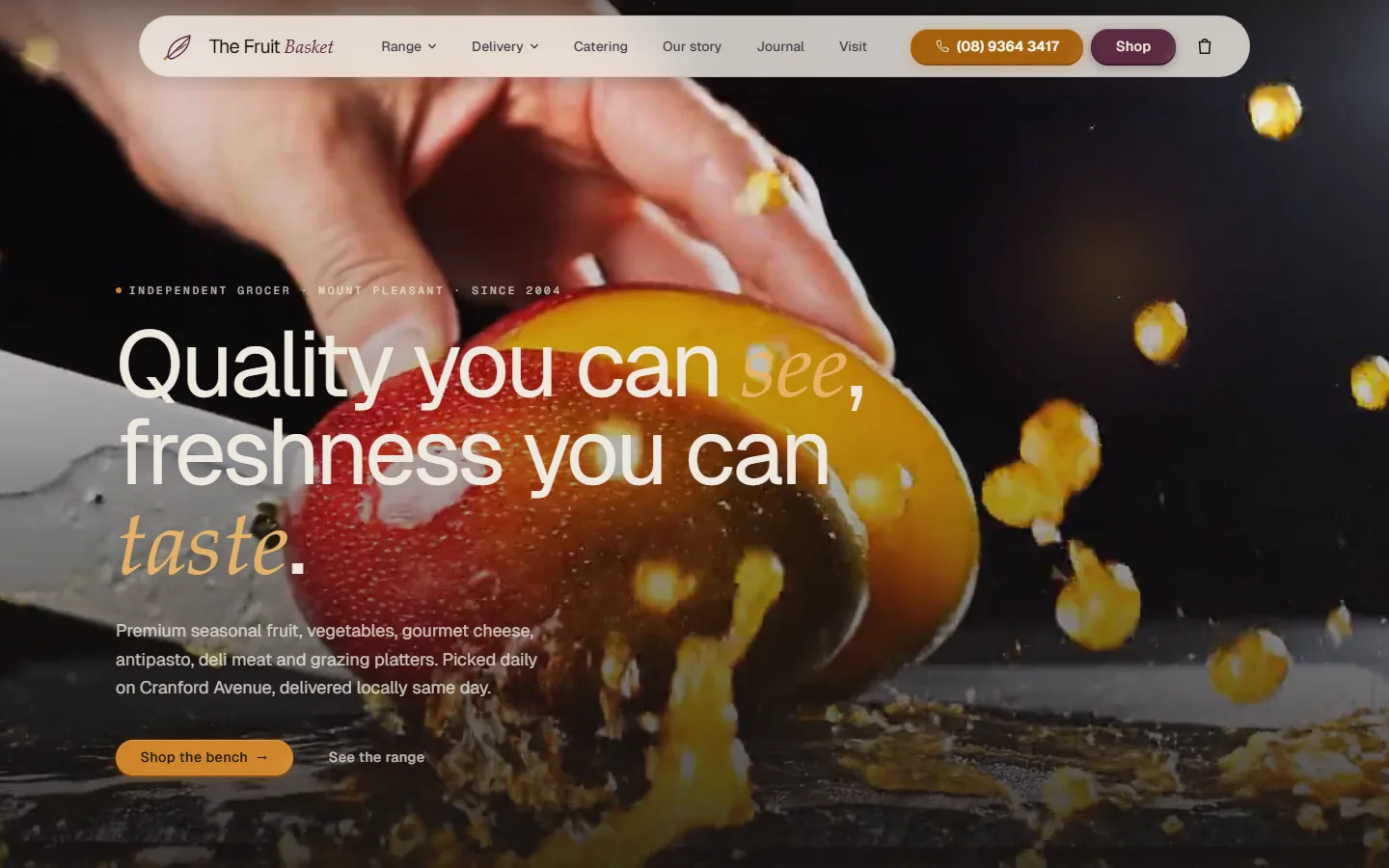
The business
The Fruit Basket is an independent grocer on Cranford Avenue in Mount Pleasant, Perth, trading since 2004. Mount Pleasant sits inside the City of Melville, the area on Kovus’s web design in Melville page. It’s a proper neighbourhood shop under new ownership: seasonal fruit and veg, gourmet cheese and deli meat, grazing platters, and the kind of stock a supermarket can’t be bothered curating. Open seven days from 7am, with a A$30 minimum for local delivery across 18 suburbs from Applecross to Willetton, and no minimum on Click and Collect. The shop opened as Brentwood Fresh in 2004 and took the current name later.
What they had before
No website that told this story. The shop’s real activity, this week’s stone fruit, the loaded platters, the regulars who order every Friday, lived on a Facebook page and Google Business Profile, and nowhere else. There was no analytics and no Search Console verified on any domain, so nobody could see what was actually working. A legacy Rails e-commerce site from a previous owner era had gone offline years earlier. At launch, online ordering ran through a third-party catalogue, A Better Choice, rather than anything built here, and internally the shop investigated Shopify and then a Merlin POS product-sync before concluding both were overkill for a single-store operation at this volume.
The Business Profile was already busy. Across the first half of 2026 its dashboard showed over 25,000 profile views and 3,200 or more searches surfacing the profile, and when this case study was first published in July 2026 the shop sat third in the map results for “grocery store mount pleasant wa” on 29 reviews.
What we built
A site with 18 hand-written suburb delivery pages, each carrying its own distance, drive time, same-day cut-off, three local-context notes and a landmark list, rather than one paragraph that name-drops every suburb it wants to rank for. Each suburb page answers its own FAQs from real, suburb-specific facts (distance, cut-off, the delivery minimum, nearby landmarks), not templated copy repeated 18 times.
Beyond the suburb pages: a produce-led range section split by category (fruit and veg, cheese and antipasto, meat and deli, platters, pantry), a catering page, a shop that launched as a browse-only preview with add-to-cart disabled, so no order could be placed against a mock catalogue, and now takes orders for same-day delivery and pickup, and a weekly-specials-style content structure. A weekly specials structure is the centre of Kovus’s approach to greengrocer websites. The produce photos are compressed to load quickly on a phone with no visible loss, and three grazing and cheese-board shots were enlarged so they hold up at full width.
Every page carries structured data that tells search engines it is a grocery store, and a plain-text summary helps AI search tools describe the shop.
Since launch the site has grown a blog that ran to ten posts by 12 October 2026, written around what the shop actually gets asked and what is in season: ripening avocados and mangoes, stone fruit season in Perth, what is on the bench in winter and in spring, a platter guide, office platters for Melbourne Cup, a staff lentil soup recipe and a piece marking twenty-two years on Cranford Avenue. That is the layer that keeps a grocer’s site worth returning to between shops, and it is the reason the sitemap lists 49 pages rather than the launch set.
What Search Console shows
Before this build nothing measured the shop’s search traffic. Search Console was verified for the domain on 29 June 2026, and visitor analytics went live the same day. Search Console’s data reaches back to the site’s first impression in Google Search, on 25 June 2026.
The figures below were taken from Search Console on 12 October 2026, for fruitbasketperth.com.au and Google web search only. Search Console runs a few days behind, so the last complete day is 9 October.
| Period (2026) | Clicks | Impressions | Average position |
|---|---|---|---|
| 25 June to 9 October | 621 | 21,626 | 19.6 |
| July | 127 | 2,978 | 20.8 |
| August | 164 | 6,264 | 21.9 |
| September | 245 | 9,149 | 19.6 |
In the 28 days from 12 September to 9 October the site took 224 clicks from 8,310 impressions at an average position of 15.8. The 28 days before that, 15 August to 11 September, had 190 clicks from 8,042 impressions at 22.4.
Google reported 1,816 different search queries that showed the site between 25 June and 9 October. It withholds rare queries for privacy, so the true number is higher, and 331 of the 621 clicks came from queries it did not name. Of the 290 clicks it did tie to a named query, 170 came from searches that do not contain the shop’s name. Platters lead them:
- “fruit platter perth”: 35 clicks from 186 impressions, average position 7.7 over the whole period and 6.5 in the 28 days to 9 October.
- “fruit platters perth”: 31 clicks from 162 impressions, average position 8.3.
- “fruit platter”: 21 clicks from 974 impressions, average position 21.9.
The platters range page is the most-clicked page after the homepage, with 146 clicks from 3,113 impressions over the same period. Searches for the shop itself still matter: “the fruit basket” brought 33 clicks at an average position of 8.0, and “fruit basket brentwood” 32 at 3.0.
On 12 October 2026, Search Console reported 44 of the 49 pages in the site’s sitemap as indexed. The other five, four suburb delivery pages (Attadale, Booragoon, Brentwood and Willetton) and one blog post, are known to Google but not indexed yet.
What the numbers don’t show
Clicks are not orders, and the shop’s sales stay private. These figures start from zero on a new domain and cover its first season in search, spring demand for fruit and platters included. Most of the clicks landed on the homepage, and the 18 suburb delivery pages drew 2 between them.
What’s included
A one-off build plus a month-to-month retainer covering GBP management, tracking and content upkeep. The site, the suburb pages, the schema and the domain are the shop’s from day one. Cancel the retainer at any time and everything stays with the business.