// for render & plaster crews
Websites for renderers that separate the finishes.
Acrylic, sand, cement, polished plaster and stack-stone are quoted per square metre on whole elevations, not as an after-hours callout. Architects and builders shortlist from labelled finish photos and applicator certificates. Builds cost A$500 to A$1,000; see pricing.
// the approach, shown
A rendering site, built as a concept
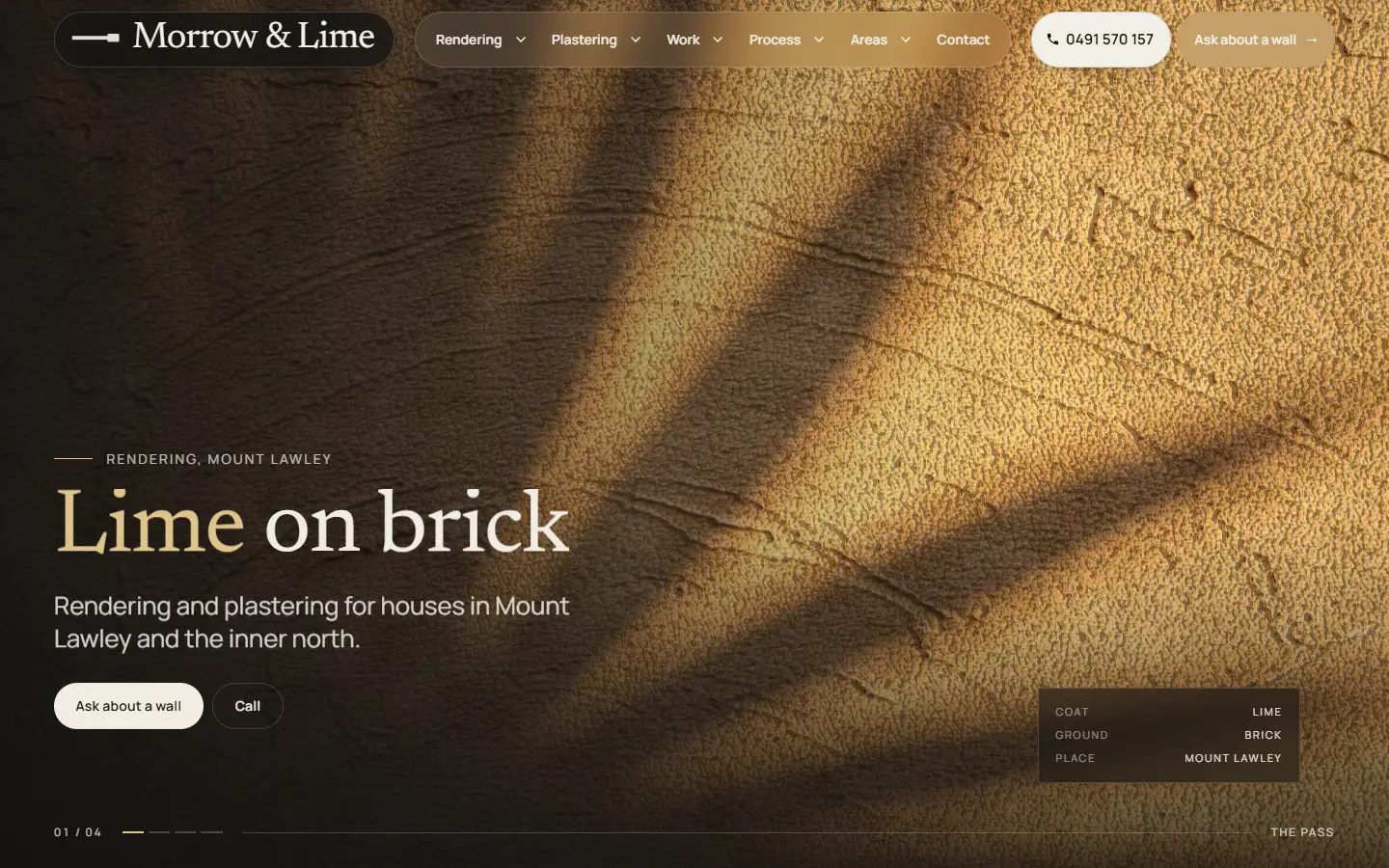
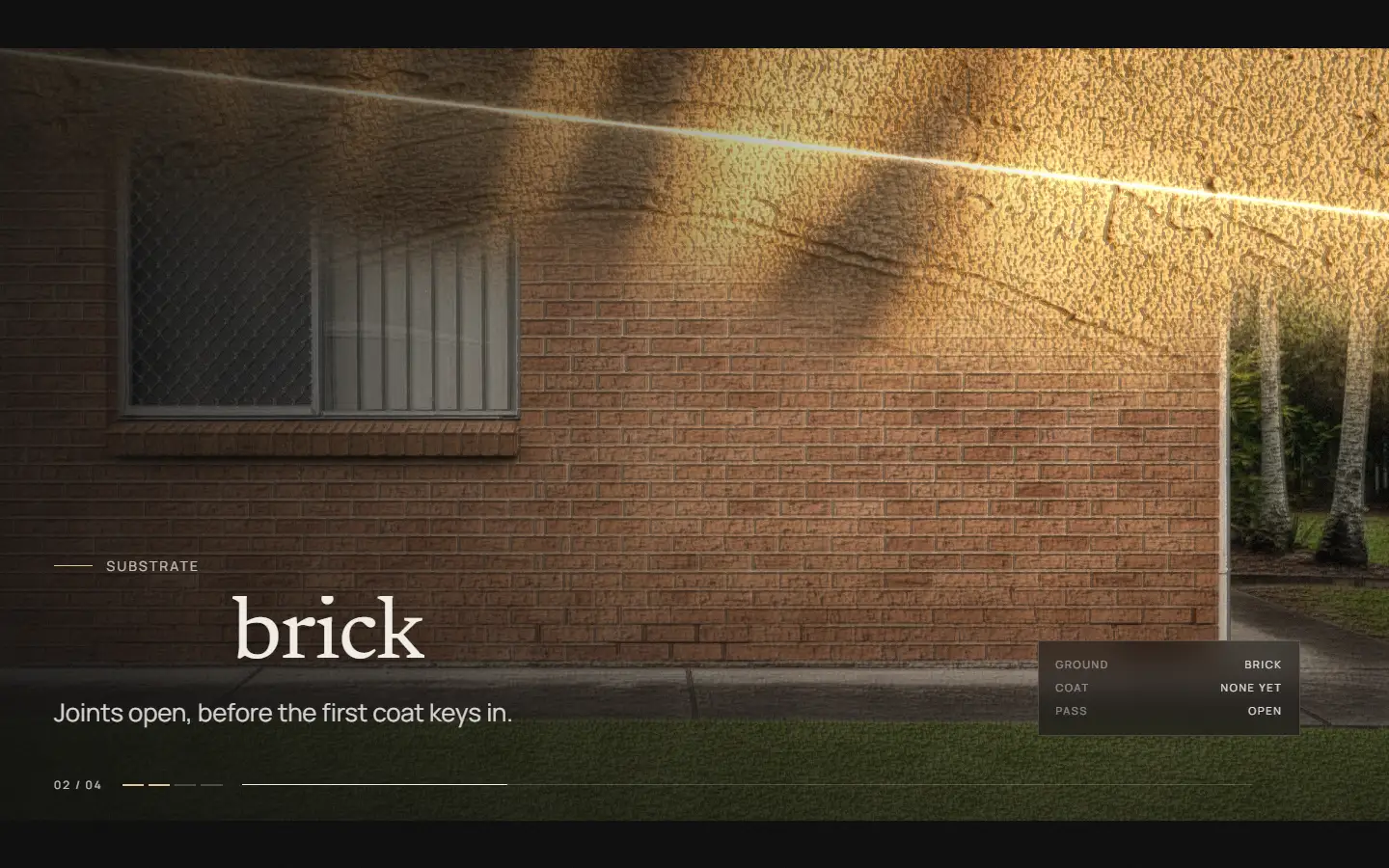
Kovus built this rendering site for a fictional business to show the approach: a scroll-driven hero made from the trade itself, service pages and one clear enquiry path.
// concept build
Concept build
// the problem
What an architect checks before a renderer makes the shortlist.
Site does not survive an architect's first look
Render work is won on a shortlist, not a 9pm callout. An architect or a builder opens the site to check whether the finish photos look like the specification, then they move on if the gallery is six dim phone snaps of beige. A plumber-style tap-to-call bar is the wrong object for that buyer.
Acrylic, sand, cement and polished on one page
Acrylic, sand finish, cement render, polished plaster and stack-stone are different buyers with different substrates and different searches. A homeowner comparing Rockcote colour on a Cottesloe elevation is not the specifier looking for polished plaster on a feature wall. A single 'we do all rendering' homepage cannot carry both.
Applicator certificate buried in a PDF
Builders check whether you are a certified Rockcote, Dulux AcraTex or Unitex applicator before they put you on a tender list. If that ticket lives in a footer PDF, or is missing, the shortlist closes on the crew who put the certificate next to the gallery. Do not name a system you are not accredited to spray.
Priced like a callout, quoted like an elevation
Render is priced per square metre on a whole wall, not as an after-hours call-out fee. Buyers already search acrylic render cost per m2 Perth and cement render vs acrylic. A silent 'call for a quote' form sends them to the crew who published a from-rate by finish.
Nobody calls a renderer because a wall failed at 9pm. The call comes from a builder who already has three crews on a shortlist, or from an architect who opened your site to see whether the finish photos look like the specification. Homeowners do the same more slowly: they want a Cottesloe elevation in acrylic, a sand finish on a limestone cottage, or a polished-plaster feature wall, and they will not type “emergency renderer”. They type “acrylic render Perth”, “sand finish render”, “cement render vs acrylic”, “polished plaster” and “Rockcote applicator”. They compare sample boards and colour charts, then they look for a crew that has already done that finish on brick, Hebel or blueboard.
If the site looks like a 2015 brochure and the gallery is six dim phone snaps of beige, the shortlist closes without you. Finish, substrate and a named system are what they are checking. A tap-to-call bar copied from a plumber site is the wrong object.
Acrylic, sand, cement, polished plaster and stack-stone are different buyers. Acrylic (Rockcote, Dulux AcraTex, Unitex) is the renovation and coastal elevation job, sold on colour, flexibility and a from-rate per m2, especially on salt-hit walls in Fremantle and Cottesloe. Cement render is the traditional, often repair-and-match job on older brick, and it weathers differently. Sand finish is a texture decision, not a synonym for acrylic. Polished plaster is an interior, specifier-led finish that lives on a feature wall, not on a whole two-storey elevation.
Stack-stone is a cladding look that does not belong on the same page as a hardwall set. A single “we do all rendering” homepage cannot rank for those queries and cannot reassure an architect that you have done that finish on that substrate: brick, Hebel, blueboard or painted masonry. Each finish needs its own page, with photos labelled finish, substrate, suburb and square metres, plus the applicator certificate for the system you actually spray.
The other thing a builder checks, after the photos, is whether you are a certified applicator and whether the site talks in m2 rather than “call for a quote”. Put the Rockcote, AcraTex or Unitex ticket next to the gallery, not in a footer PDF. Give a from-rate per square metre by finish, marked as a starting point, because that is the unit every elevation is quoted in. The form should ask finish, substrate, approximate m2, new work or over-render or repair, and a photo of the elevation.
Over-render of a failed acrylic coat is a different quote to a new Hebel elevation, because the old system has to be tested and often stripped. Perth winter rain stops exterior acrylic and cement. Summer is when coastal jobs in Fremantle, Cottesloe and Mosman Park want to move. Interior polished plaster fills the wet months. The site has to show finish, substrate and a m2 rate so a builder can shortlist you without a wasted site visit.
What a render site carries
Pulled together, a render site that makes a builder’s shortlist has five parts:
- Finish-specific pages: acrylic, sand, cement, polished plaster, stack-stone.
- Photos labelled finish, substrate, suburb and square metres.
- Applicator certificates (Rockcote, Dulux AcraTex, Unitex) next to the gallery, only for systems actually held.
- A specifier path for architects and builders, separate from the homeowner colour-and-texture path.
- Quote fields: finish, substrate, approximate m2, new work or over-render or repair, elevation photo.
How homeowners find a render crew
Google says its local results are mainly based on relevance, distance and prominence (Google Business Profile Help). For a renderer, relevance is a page per finish, distance is suburb copy for the areas the crew actually works, and prominence is reviews and labelled jobs. In Backlinko’s local-search study, 42% of searchers clicked a result in the Google map listings (Backlinko search behaviour study), so the Business Profile should name the same finishes and suburbs as the site.
The seasons give the site a calendar as well. A homeowner reading in May about winter delays on exterior acrylic, and in October about booking a coastal elevation before the summer rush, is reading a crew that plans its year. A short page on how the weather moves the programme, linked from each exterior finish, answers the question before the builder has to ask it.
// built by Kovus
Built by Kovus for other trades.
The concept site above is for a fictional business. These are real client sites for other trades, each linked to its case study, and the same approach carries over to a render site.
 Metal roofing and cladding McDonald Roofing Company Wangara, Perth 12 service-area pages grouped into three Perth regions. Read the case study
 Exposed aggregate and honed concrete CJH Concrete Currambine, Perth
 Plumbing and gas Donza Plumbing Mannering Park, NSW
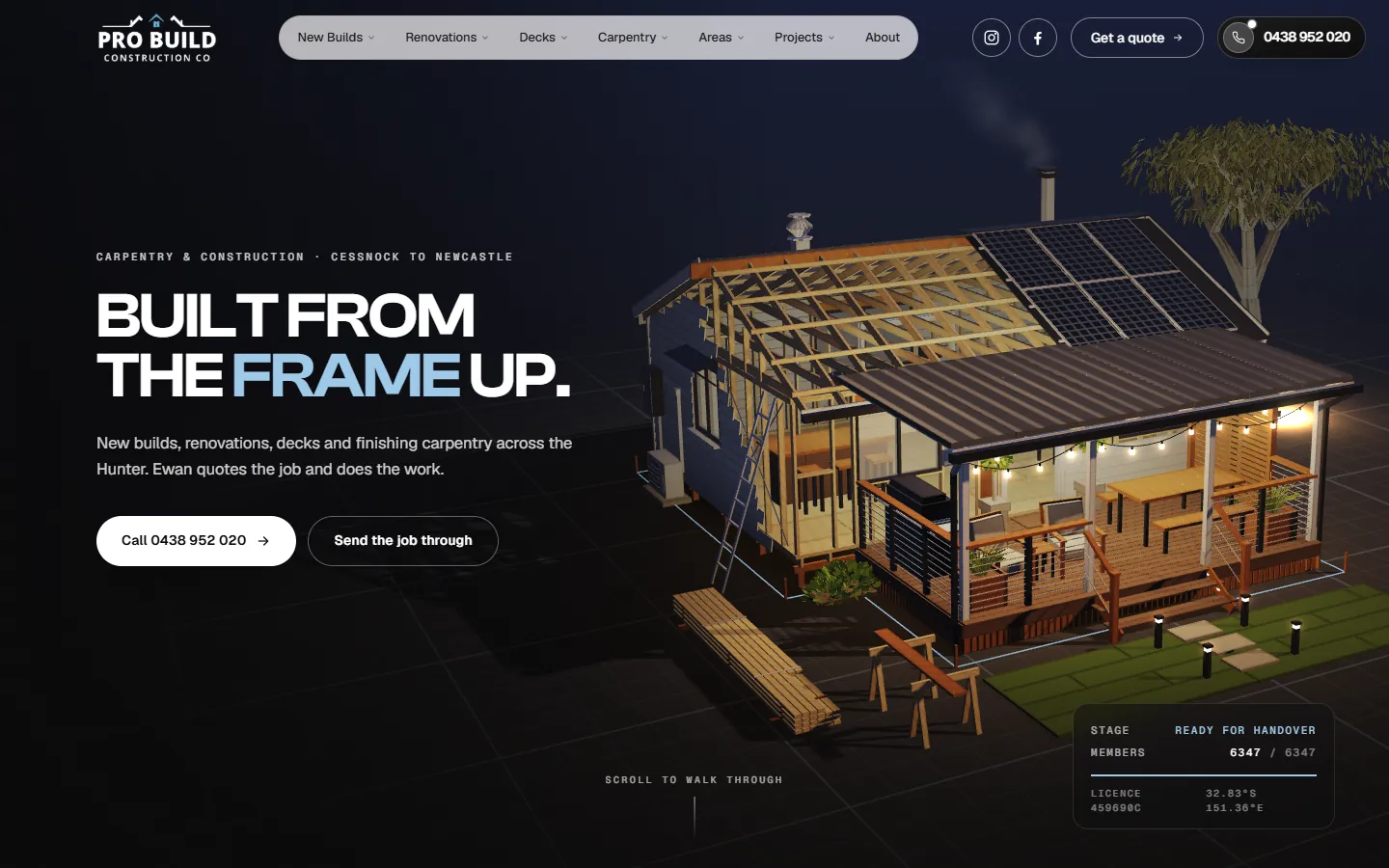 Carpentry and construction Probuild Construction Co Cessnock, NSW
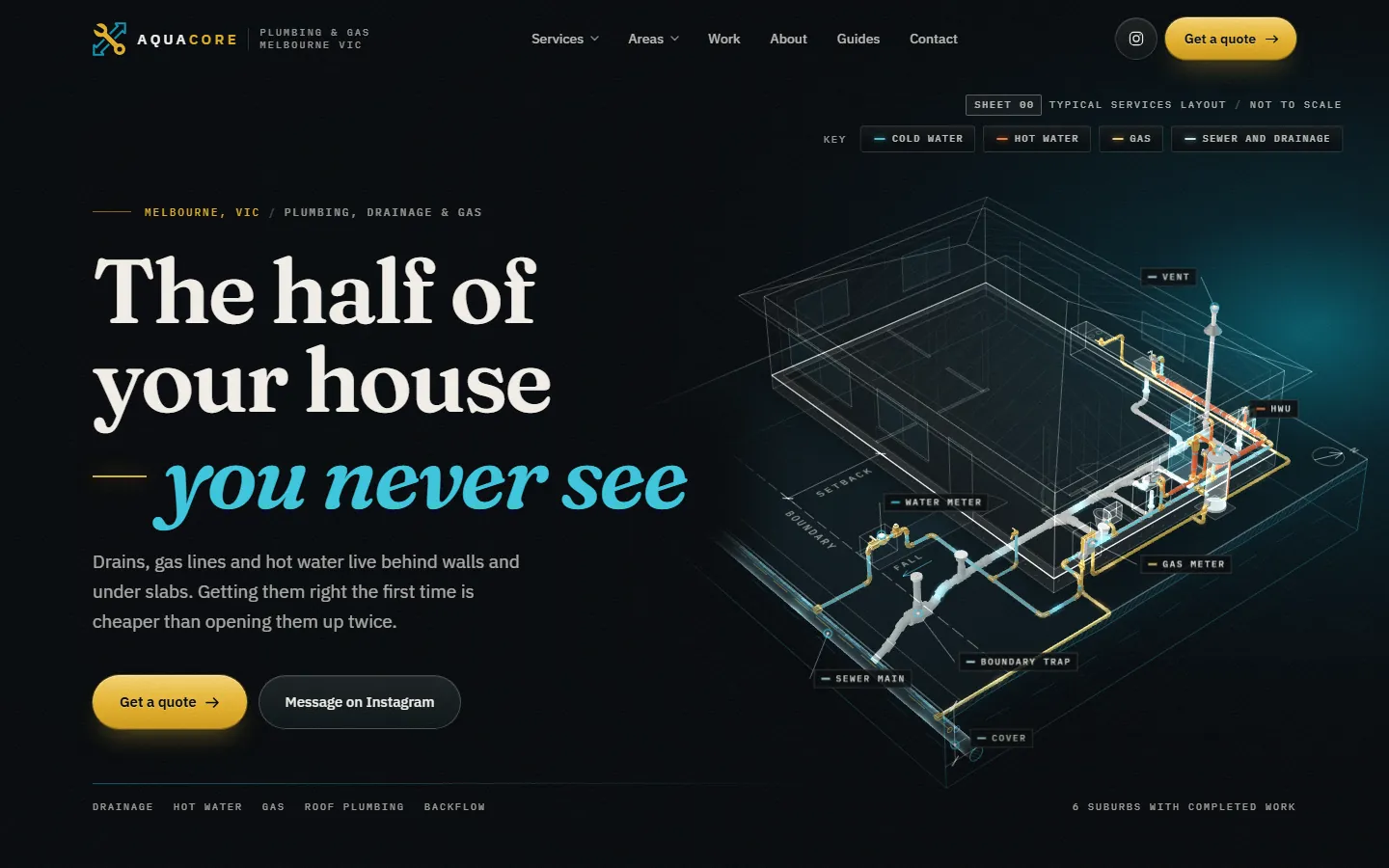 Plumbing AquaCore Plumbing Melbourne, VIC
 Roof tile repairs and restorations Mandurah Roofing Services Mandurah, WA
// the numbers
Checked before a specifier opens it, measured after launch.
Mobile, accessibility and technical search checks recorded before launch
/ Launch QA
Agreed enquiry events and available search data reported against the baseline
/ Client reporting
// prices and terms
What a website for renderers costs.
- Website build
- A$500 to A$1,000, quoted in writing for the pages and integrations the business needs. A Premium build for a bigger site starts at A$1,000. What Premium covers.
- Hosting and edits
- A$97 a month covers hosting, security, backups and unlimited edits. What website maintenance covers.
- SEO and Google Business Profile
- From A$197 a month, adding Business Profile work, Search Console, directory listings, review requests and a monthly report. SEO for tradies.
A quote-scoped one-off build is available without ongoing services, which are quoted separately. The client owns the website, content, domain and source code. Optional ongoing services are month-to-month with no minimum term. The client may cancel at any time, effective at the end of the current paid month. Full pricing and terms.
// straight answers
What render crews ask before a quote.
- Should acrylic, sand, cement and polished plaster each have their own page?
- Yes, if you actually sell those finishes. Each one is a different search, a different substrate conversation and a different buyer. Acrylic is the renovation and coastal elevation job. Cement is often repair-and-match on older brick. Sand finish is a texture decision. Polished plaster is interior and specifier-led. Stack-stone is a cladding look. One services paragraph cannot rank for those queries or reassure an architect.
- Do Rockcote or AcraTex applicator certificates belong on the homepage?
- Yes, next to the gallery, if you hold them. Builders and architects look for a named system and a current applicator ticket before they request a rate. Put the Rockcote, Dulux AcraTex or Unitex certificate you actually have in the trust block. Naming a system you are not accredited for is worse than naming none.
- Do architects actually look at a renderer website before they call?
- Yes. They are checking finish photos against a specification, substrate notes and whether the site looks like a crew they can put in front of a client. They are not ringing an emergency number. Labelled photos (finish, substrate, suburb, m2) and a specifier path do more for that shortlist than a tap-to-call bar copied from a plumbing site.
- Should I publish render cost per m2?
- A from-rate per square metre by finish is the unit every elevation is quoted in, and it is what people type when they search acrylic render cost per m2 Perth. Mark it as a starting point. Hebel, blueboard, painted masonry and a failed over-render all move the figure. Interior polished plaster sits on its own band because it is not a two-storey exterior coat.
- What should a render quote form ask?
- Finish, substrate, approximate m2, and whether it is new work, over-render or repair. Add a photo of the elevation and the suburb. That is enough to see whether a salt-hit Cottesloe acrylic job is a fit, or whether someone wants a small interior polished-plaster wall that you do not take. Name and phone come after those fields, not instead of them.
- How much does a website for renderers cost?
- A standard render build costs A$500 to A$1,000. The quote prices a page for each finish you apply, such as acrylic, sand, cement and polished plaster, with labelled elevation photos on each. A Premium build, for a bigger site built to a higher finish, starts at A$1,000. Ongoing work is optional: A$97 a month covers hosting, security, backups and unlimited edits, and from A$197 a month adds SEO and Google Business Profile work.
- Who owns the render site and the finish photos?
- The client owns the website, content, domain and source code from launch. For a render crew, that includes the finish pages, the labelled elevation photos and the applicator certificate details shown on them. The monthly plans are month to month with no minimum term, and cancelling takes effect at the end of the current paid month.
- Will the site rank when someone searches for a render finish?
- No quote includes a ranking, because Google decides that. The build names each finish on a page of its own, so a search for acrylic or polished plaster has somewhere specific to land, with structured data and a fast mobile layout underneath. After launch, the SEO plan keeps the Business Profile, directory listings and review requests current and checks Search Console every month, with a report on what changed.
// the framework
Scope finishes, substrates and the specifier path.
Kovus builds a render site for the specifier as much as the homeowner: finish pages, applicator proof and quotes by the elevation. How the five scoped areas work.
The same build sits behind all Kovus websites for tradies, scoped here to renderers.
// practical guides
Field guides for rendering businesses
// built from Perth
A Cottesloe acrylic elevation is not an inland cement repair.
Kovus is based in Perth. How render search splits across the metro is covered on Web Design Perth.
Scope a render site that separates the finishes.
Send the finishes you apply, the applicator certificates you hold and a few labelled elevation photos. Josh quotes a page per finish, in writing, before any work starts.
Or call Josh on 0423 155 979 or email josh@kovus.dev.