A plumbing business gets two kinds of call. One is water through the ceiling, and the caller wants someone on the phone now. The other is a hot water replacement or a backflow test that is due, where the customer compares a few businesses first. Most of the work below serves both, and most of it costs nothing but time.
This is the order I would do it in for a plumbing business in Australia. It starts with what Google gives you free, then the website, and leaves paid leads until you can see what each enquiry costs. The Google rules in it come from Google’s own help pages, each linked where it is used.
I build websites and run local SEO for trades, so the website steps are work I sell. The channels every trade shares, such as directories, social media and content, are covered in marketing for tradies. This guide stays on what is different about plumbing.
Digital marketing for plumbers, in order
Eight steps, grouped by when they matter. The first five are free or a one-off cost, and they stay with the business when the spending stops. Paid leads come last, once calls and enquiries are being counted.
Before the phone rings
- Set up the Google Business Profile as a service-area businessAddress hidden, up to 20 suburbs or postcodes, one profile for the whole area.A$0Google charges nothing
- Show only the hours someone answersNight and weekend hours only if the phone is picked up, and no "24/7" in the name.A$0Part of the profile
What the caller reads
- Give each plumbing job its own pageEmergency work, hot water, blocked drains, gas and backflow, each answered on its own.One-offA standard Kovus build is A$500 to A$1,000
- Add suburb pages where you have work to showA job done there, not a page with the suburb name swapped.In the buildOnly for real work
- Put your licences and ABN where customers checkEach licence on the page for the work it covers.A$0You hold them already
After the job
- Ask for reviews the way Google allowsIf you ask, ask everyone, with a link or QR code and nothing offered in return.A$0Never paid for
- Count calls and enquiriesProfile calls, website calls and forms, and where each job came from.A$0Search Console is free
Only then
One plumbing business, from Instagram to its own site
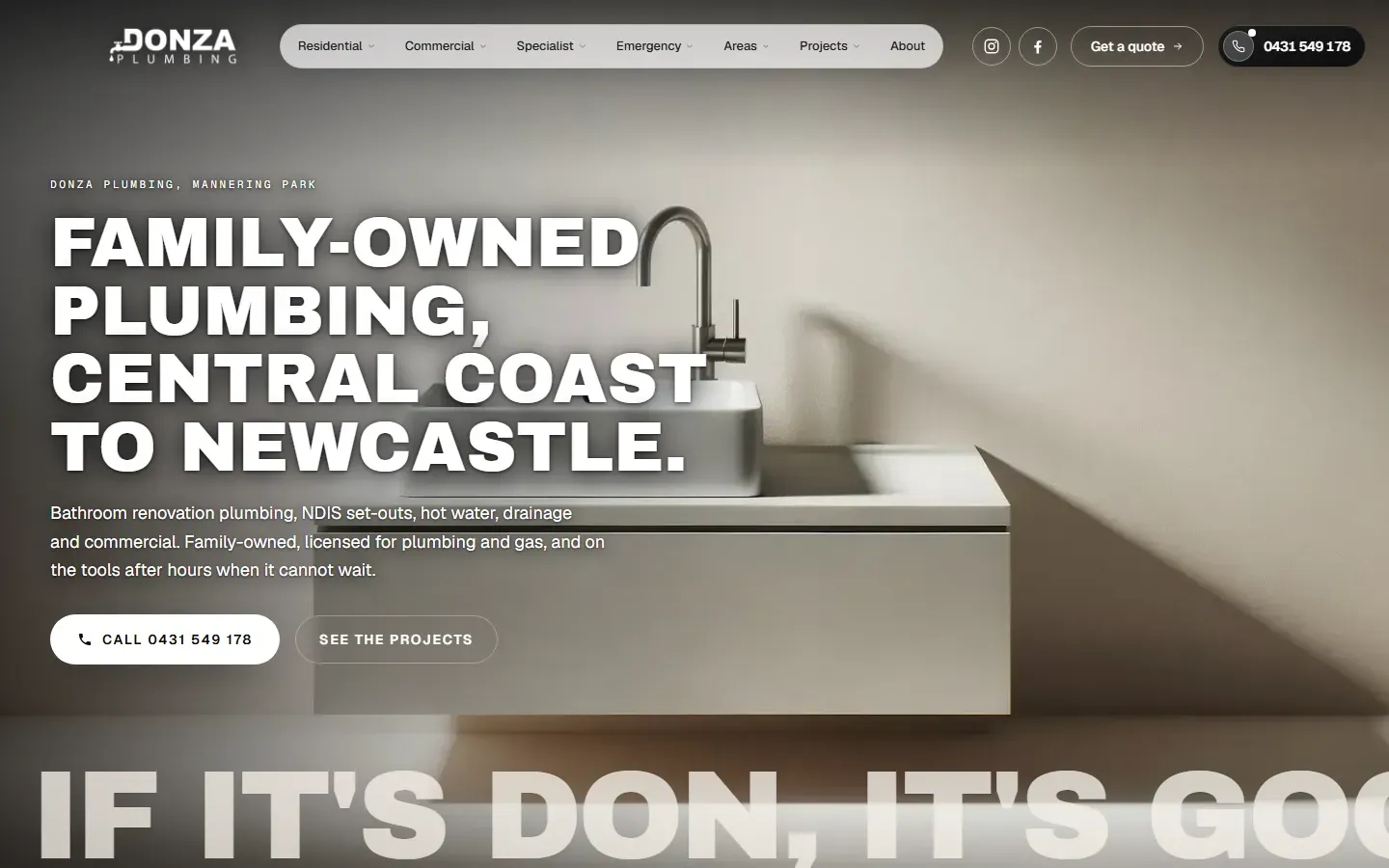
Donza Plumbing is a family-owned plumbing and gas company at Mannering Park, NSW, working from the northern Central Coast through Lake Macquarie to Newcastle. I built its website. Before that, the whole public presence was one Instagram account. The bio said “DM for a quote”, and every enquiry arrived as a message.
| What | Before | Now |
|---|---|---|
| Website | None | Its own domain, with 139 pages at launch and 150 now |
| A page for each job | None | Thirteen service pages split by job type, emergency plumbing among them |
| Suburb pages | None | 100 at launch and 103 now, across the corridor the business works |
| Google Business Profile | None | Verified, and set up as a service-area listing |
| How customers got in touch | Instagram messages | The mobile number and the ABN on every page of the site |
The full build is written up in the Donza Plumbing case study. The steps below follow the same order.
Before the phone rings: your profile and your hours
1. Set up your Google Business Profile as a service-area business
The profile is free, according to Google’s own Business Profile page, and it is the listing Google shows for your business on Maps and in local results. A plumber who works at customers’ homes is what Google calls a service-area business, and Google’s help page on service areas names plumbers as an example. These are the rules that matter:
- Hide the address. Google’s guidelines for representing your business say that a plumber who runs the business from home should clear the address from the profile.
- List up to 20 service areas, by suburb, postcode or another area. Google does not accept a radius drawn around your base.
- Keep the whole area within about two hours’ drive of where the business is based. That is the outer edge Google gives.
- Keep one profile for the whole area. A service-area business gets one profile, not one for each suburb.
- List each job as a service, such as burst pipes, hot water, blocked drains, gas fitting and backflow testing, rather than one line that says plumbing.
Google’s page on local results names three things it weighs: how well the profile matches the search, how far the business is from the person searching, and how well known the business is. It also says a better local ranking can’t be requested or bought. A plumber can’t move closer to every caller, so the work goes into the other two, which a complete, accurate profile and steady reviews help with.
The setup itself, step by step, is in the Google Business Profile guide.
2. Show only the hours someone answers
Burst pipes do not wait for business hours, which makes hours the part of the profile that matters most for a plumber. Google asks for your “regular customer-facing hours”. For a plumbing business, that means the hours someone picks up the phone.
- If nobody answers after 6pm, the profile should not say you are open. A caller who rings out at 10pm rings the next plumber.
- If you do take night calls, set the hours to match, and give emergency work its own page on the website with the number on it. Google’s guidelines also allow More hours for particular services, which Google says should generally sit inside your main hours.
- Confirm your public holiday hours. Google’s help page on special hours suggests confirming hours for official holidays even when they are the same as usual.
Keep “24/7” and “emergency” out of the business name. Google’s guidelines list hours information as something a name must not include, using “Open 24 hours” as the example, and say that unnecessary information in the name could get the profile suspended. Service words and place names are on the same list. The name stays as it is on the van, the website and the invoices, and the hours say when you are open. If a profile has already been suspended, the steps are in Google Business Profile suspended.
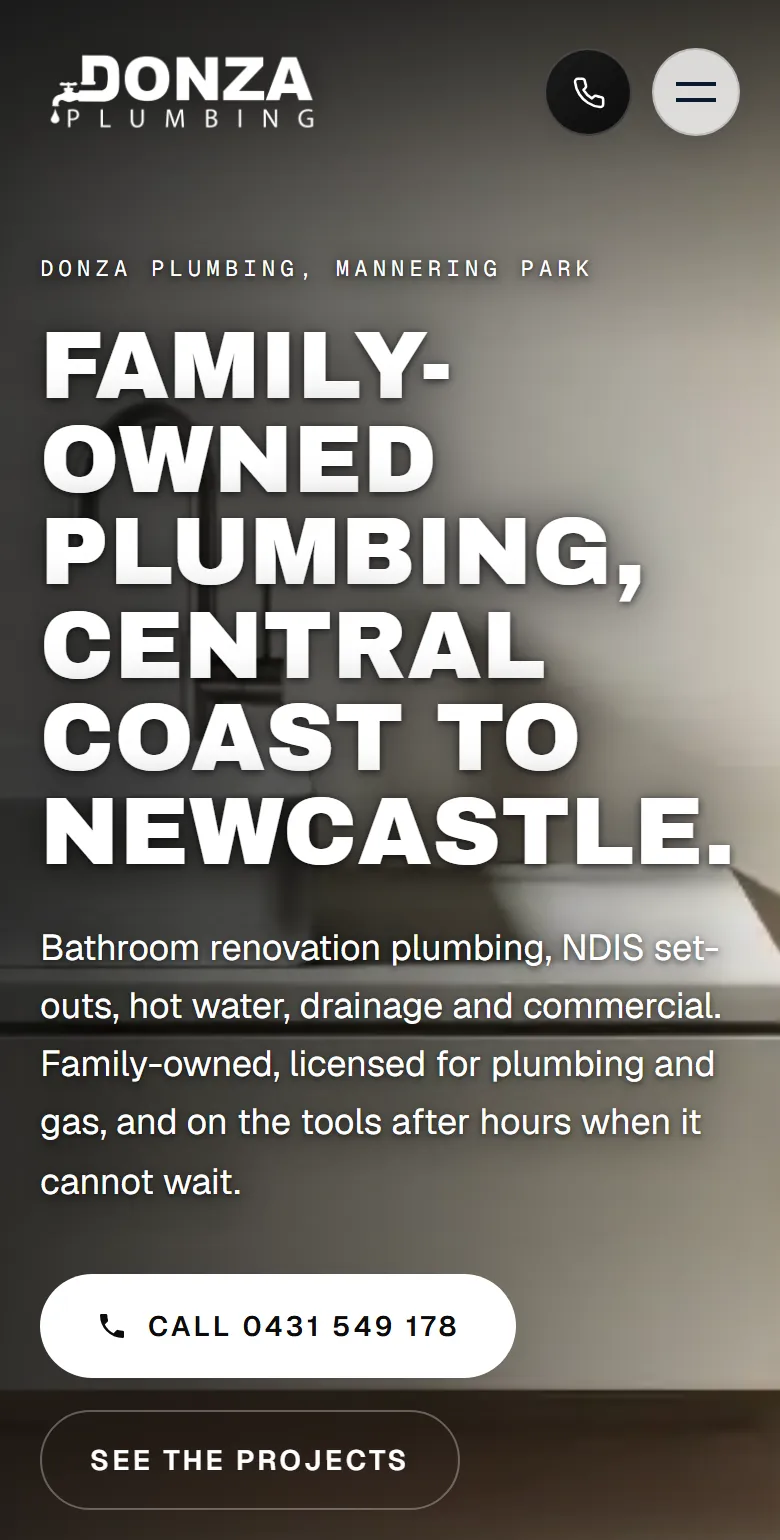
On the website, the number belongs on every page, where a thumb can reach it. Donza Plumbing’s site carries its mobile number on every page, and emergency plumbing has a service page of its own.
What the caller reads: job pages, suburbs and licences
3. Give each plumbing job its own page
A burst pipe, a cold shower, a gas smell and a backflow test due next month are different searches from different people. One services list answers none of them well. Give each job a page that answers what that customer asks:
- Emergency work: what you treat as an emergency, the hours you answer and the number.
- Hot water: the system types you install and repair, and what changes the price.
- Blocked drains: the methods you use, by name.
- Gas fitting: the work you are licensed for, with the licence on the page.
- Backflow testing: the devices you test and what the customer gets at the end.
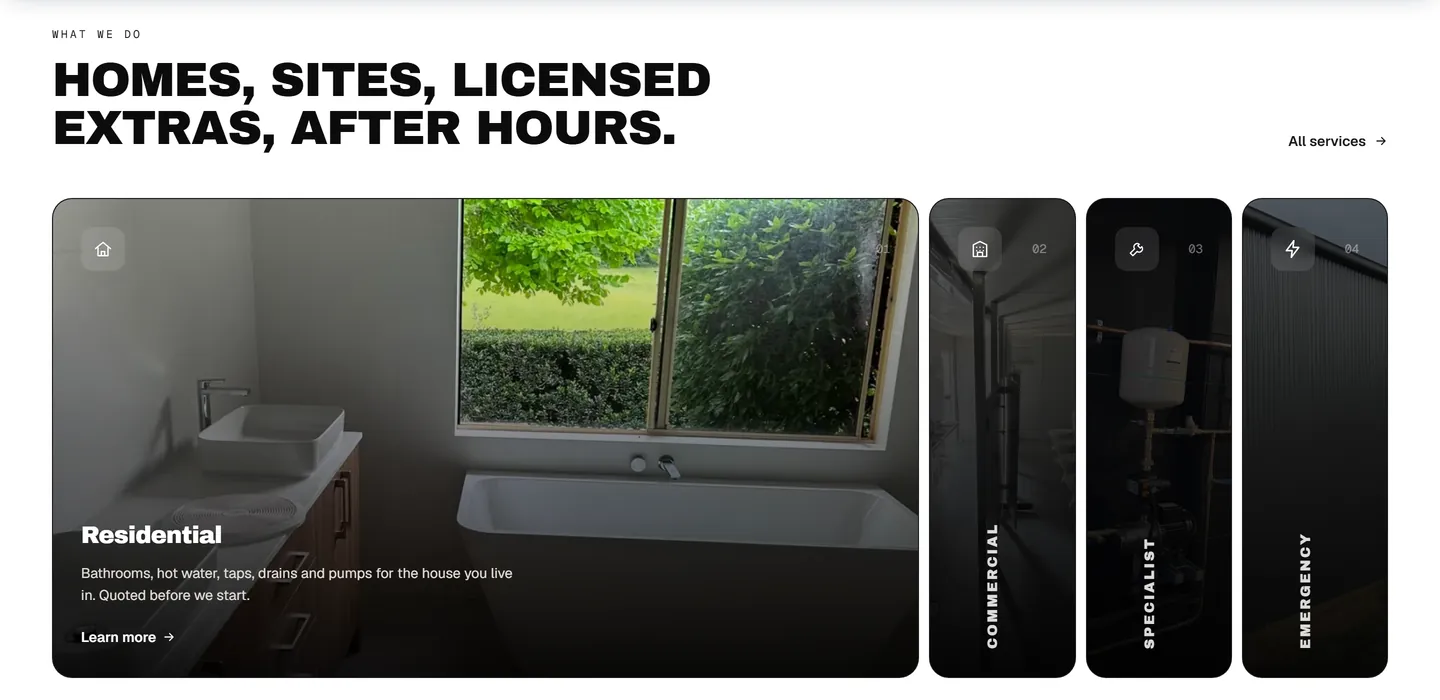
Donza Plumbing’s site splits the trade into thirteen service pages by job, from hot water and blocked drains to gas fitting, backflow prevention and emergency plumbing. It also has seven guides to questions the business gets asked, such as what a hot water replacement costs and what to do with a burst pipe, and a hot water check that asks the age and type of the unit before pointing to the right service page.
Which pages a plumbing site needs, and why the jobs are split, is set out on the page about website design for plumbers. Ten examples from two live plumbing sites, each with a screenshot, are in plumber website design examples. A standard Kovus build costs A$500 to A$1,000, quoted in writing. Other builders set their own prices.
4. Add suburb pages where you have work to show
A plumber covers a lot of suburbs, and it is tempting to make a page for each one with only the name changed. Google’s spam policies treat that as doorway content: pages aimed at particular cities or regions that funnel people to one page, or pages so alike that they read like search results. A suburb page earns its place when it has something only that suburb has, such as a job done there and its photos.
The profile’s 20 service areas and the website’s suburb pages are separate decisions. A suburb can sit in the profile’s service area without a page of its own.
Donza Plumbing’s site has 103 suburb pages, up from 100 at launch, across the corridor the business actually works, and each one carries its own location details for search engines instead of sharing a footer list. AquaCore Plumbing, a Melbourne site I also built, handles it another way: six of its 22 suburb pages show a completed job with a link to the original post, and the other sixteen say plainly that no job is tagged there yet. When a suburb has earned its own page is covered in service pages versus suburb pages.
5. Put your licences and ABN where customers check
Gas fitting and backflow work is licensed, and a homeowner is entitled to check who they are letting in. So each licence goes on the page for the work it covers, not only in the footer, and the ABN sits on every page. Only publish a credential you hold and a customer can check.
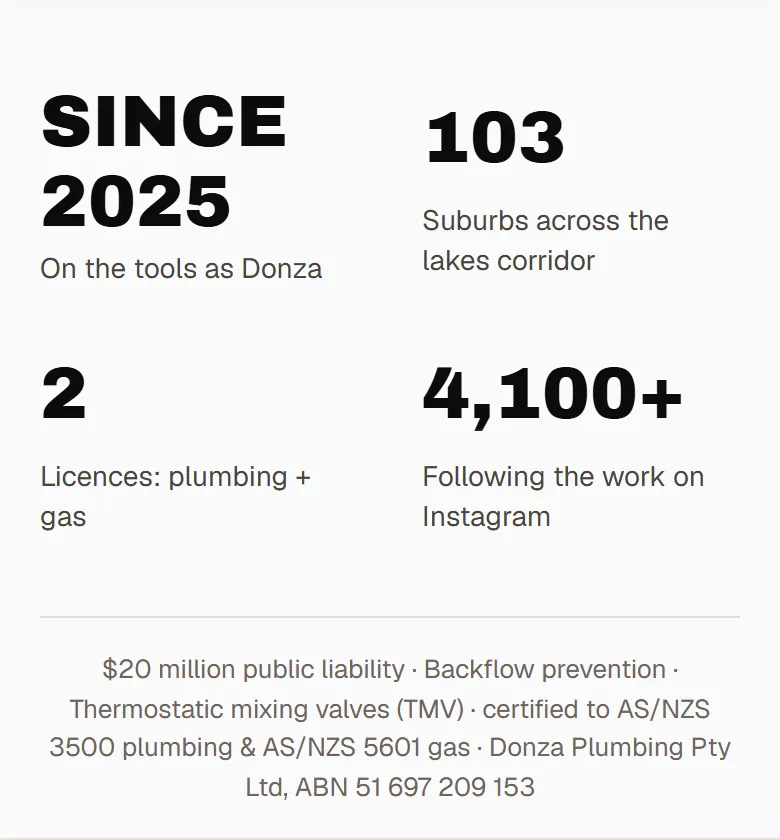
Donza Plumbing publishes its gas fitting, backflow prevention and thermostatic mixing valve accreditations in the site’s structured data, with NSW Fair Trading named as the recognising body, so search engines read the same facts as the customer. Whether a licence number has to appear in your advertising depends on your state and your trade, and for Western Australia each trade’s rule is set out in licence numbers on tradie websites in WA.
After the job: reviews and the numbers
6. Ask for reviews the way Google allows
Reviews show next to the profile on Maps and Search, and Google’s local ranking page says the number of reviews feeds into prominence. Google’s rules on asking for them are short:
- Asking is allowed. Google’s tips to get more reviews suggest a link or a QR code made from the profile.
- Nothing in return. Google treats discounts, free goods or free services offered for a review, a changed review or a removed one as fake content, and prohibits it.
- Ask everyone or no one. Google’s Maps content policy rules out selectively asking for positive reviews and discouraging negative ones.
- Reply. The same tips page suggests replying, including to the negative ones, briefly and without a sales pitch.
7. Count calls and enquiries
A burst pipe arrives as a phone call, not a form, so count the calls as well as the forms. Each of these is free:
Each month, in one place
- Calls from the profile: Google counts taps on its call button
- Website clicks and direction requests from the profile
- The searches people used to find the profile
- Taps on the phone number on the website
- Quote forms sent from the website
- Where each won job came from, asked on the phone
The profile’s numbers are in its performance report. The searches that reached the website are in Search Console, which Google describes as a free service. A few months of these numbers is the baseline every paid channel is judged against.
Only then: paying for leads
8. Pay for leads, one channel at a time
Paid channels bring enquiries while you pay and stop when you stop. With calls and enquiries counted, each one can be judged on what a won job costs. Add one, run it long enough to read, then decide on the next.
Google Ads. You set the budget. Google’s help page on average daily budgets puts the monthly limit for most campaigns at 30.4 times the average daily budget, and its own example is A$10 a day for A$304 a month. For a plumber, a useful campaign is narrow: the jobs you want in the suburbs you cover, running only when someone can answer the phone.
Lead platforms. hipages sells memberships that come with lead credits. On its membership costs page, checked 13 October 2026, the Starter plan is $139 + GST a month for 155 credits and a listing in one postcode, and Platinum is $649 + GST for 850 credits across ten postcodes. New members join on a six-month introductory term, which hipages says renews automatically on a 12-month term after it lets you know. Each lead costs credits, and its lead credits policy says the number depends on things such as the job type, size, urgency and location. The sum that decides whether it pays is in is hipages worth it.
Are Local Services Ads available to plumbers in Australia?
Not at the moment. Some plumbing marketing guides are written for the United States, where Google’s Local Services Ads charge per lead and carry a Google Verified badge. Google’s Local Services help centre covers 11 countries: the United States, Canada, the United Kingdom and eight others in Europe. Australia is not one of them, and Google’s Local Services Ads page sends an Australian visitor to its standard Google Ads page instead. For a plumber in Australia, the paid option on Google is a Google Ads campaign.
What it costs, step by step
| Step | What it costs | Where the figure comes from |
|---|---|---|
| Google Business Profile | Free | Google's Business Profile page |
| Hours, special hours and the business name | Free, part of the profile | Google Business Profile Help |
| A page for each job, and suburb pages | A one-off build. A standard Kovus build costs A$500 to A$1,000, quoted in writing, with optional hosting and edits at A$97 a month | The Kovus pricing page |
| Licences and ABN on the site | Nothing extra | The credentials you already hold |
| Google reviews | Free, and never paid for | Google's Maps content policy |
| Counting calls and enquiries | Free: the profile's performance report and Search Console | Google Search Console Help |
| Google Ads | The budget you set. For most campaigns, up to 30.4 times the average daily budget in a month | Google Ads Help |
| hipages | From $139 + GST a month for plans with leads, on a six-month introductory term | hipages, checked 13 Oct 2026 |
| Local Services Ads | Not offered in Australia | Google Local Services Help |
| Ongoing local SEO | Kovus charges from A$197 a month, month to month. Other providers set their own prices | The Kovus pricing page |
What to skip
Leave these alone
- "24/7", "emergency" or a suburb added to the business name on Google.
- Night hours on the profile when nobody answers at night.
- A service area drawn as a radius. Google takes suburbs, postcodes or other areas.
- A page for every suburb with only the name changed.
- A discount or a freebie for a review, or asking only the customers you expect to be happy.
- Gas or backflow work on the site without the licence that covers it.
- Plans built around Local Services Ads, which Google does not offer in Australia.
- A 12-month lead platform term before you have a few months of your own numbers.
Where Kovus fits
I build websites for plumbers and run local SEO, so steps 3, 4 and 5 are the work I sell, and the profile in steps 1 and 2 is part of the monthly plan. A standard build costs A$500 to A$1,000, quoted in writing, and the client owns the website, content, domain and source code. What goes into a plumbing site is on the page about website design for plumbers. The monthly work after launch, from the profile to Search Console and a plain report, is the SEO plan for plumbers, from A$197 a month and month to month with no minimum term. Google decides rankings, and they are not guaranteed.
Frequently asked questions
What is the best marketing for a plumbing business?
Start with what is free and stays with the business: a Google Business Profile set up as a service-area business, hours that match when someone answers, and a website with a page for each job. Add paid leads such as Google Ads or hipages last, once calls and enquiries are being counted, so each can be judged on what a won job costs.
Are Google Local Services Ads available for plumbers in Australia?
Not at the moment. Google's Local Services help centre covers 11 countries, including the United States, Canada and the United Kingdom, and Australia is not one of them. For a plumber in Australia, the paid option on Google is a standard Google Ads campaign.
Can I put 24/7 or emergency in my business name on Google?
No. Google's guidelines say a business name must not include hours, service details or location information, and that adding them could get the profile suspended. Use the name on your van, website and invoices, and show 24-hour work in the profile's hours, only if someone answers at those times.
How many suburbs can a plumber list on a Google Business Profile?
Up to 20 service areas, set by suburb, postcode or another area. Google does not accept a radius, and says the whole area should sit within about two hours' drive of where the business is based. How many suburb pages the website has is a separate decision.
How much should a plumber spend on marketing?
There is no figure that suits every business. The profile, Search Console and asking for reviews cost nothing. A website is a one-off build, and a standard Kovus build is quoted at A$500 to A$1,000. Google Ads costs the budget you set, and hipages plans that include leads started at $139 + GST a month in October 2026. Judge each paid channel on what a won job costs.
Can I offer customers a discount for a Google review?
No. Google prohibits incentives such as discounts, free goods or free services in exchange for a review, a changed review or a removed one. Asking is allowed, with a link or QR code made from the profile, and Google's policy also rules out asking only the customers you expect to be happy.
Does a plumber need a website if the work comes through Instagram?
Instagram shows recent jobs to people who already follow you. A website gives the Google profile somewhere to point and answers searches for each job and suburb. Donza Plumbing had 4,165 Instagram followers and no website when it was audited in August 2026. Its site now has 150 pages, with a page for each job type and 103 suburb pages.
Is hipages worth it for plumbers?
It can be when work is short and the jobs are big enough to carry the cost of each one won. New members join on a six-month introductory term that renews for 12 months, and each lead costs credits that change with the job. The sum is set out in the Kovus guide to whether hipages is worth it.