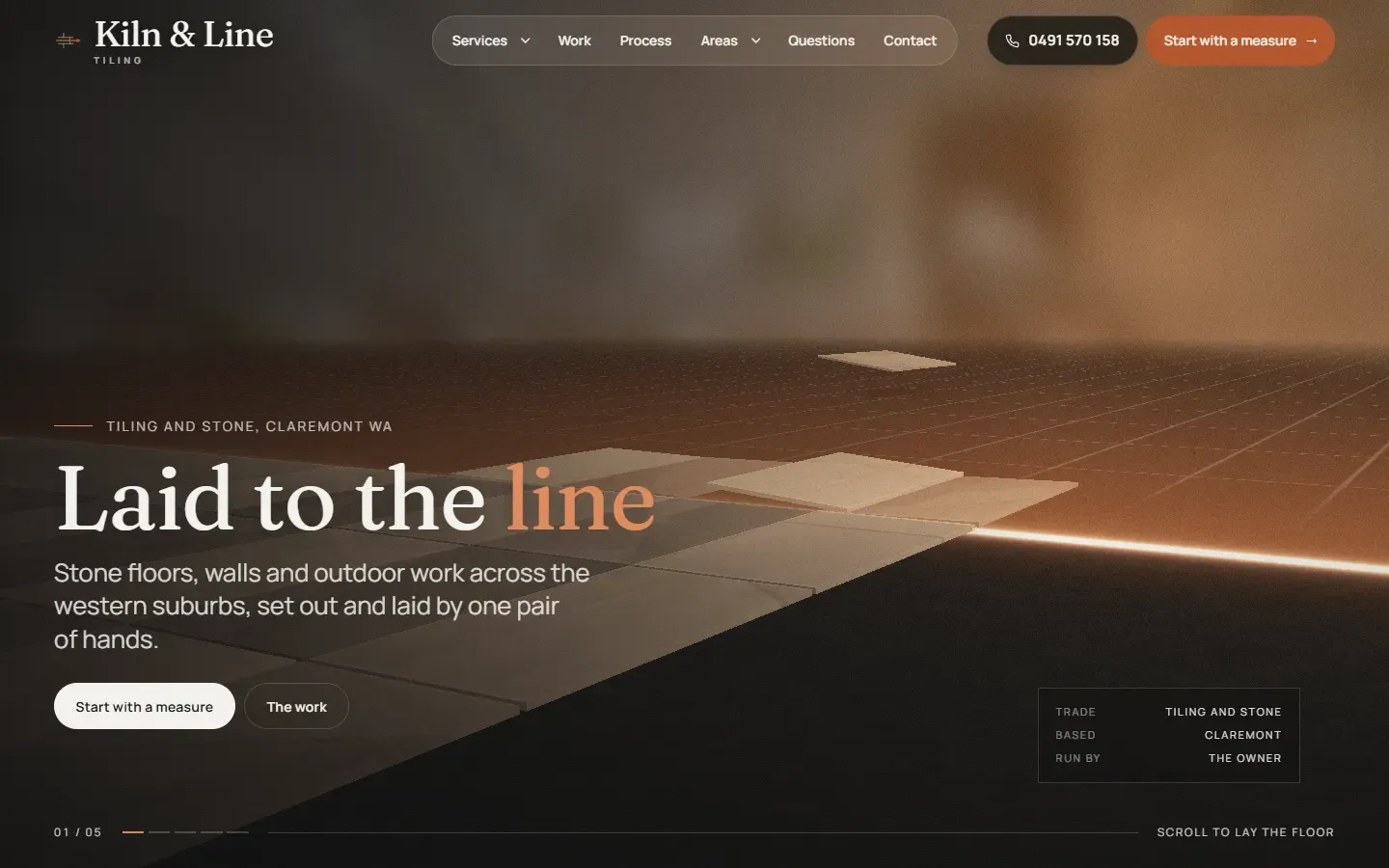
Someone pricing a bathroom renovation is usually worried about one thing more than the finish: a shower that leaks once the tiles are down. A tiling website has to answer that worry, show real rooms the business has finished and make the quote easy to ask for. This guide covers the proof, the pages and the details that do that, whether the work is bathrooms, feature stone or commercial fit-outs.
If you would rather hand the build over, the tiling website page sets out what Kovus builds for tilers, from A$500 and quoted in writing. It is the tiling side of the websites for tradies Kovus builds.
Where a bathroom retile search starts
- The job and the place. Searches such as “bathroom retile Joondalup” or “leaking shower repair near me” name the job and the area, so the site needs a page for each main service and the suburbs it covers.
- The worry. A buyer comparing tilers wants to know the shower won’t leak, so waterproofing belongs near the top of the page, not only in the FAQ.
- The proof. Before-and-after photos of real rooms, labelled with the suburb and the job, tell the buyer more than any stock image.
- The quote. Room, size, tile choice and timing are what a tiler needs to price the work, so the form should ask for them.
The problem: a tiling website that skips the one thing buyers fear
A typical tiling website is a branded blue-and-white template, a trowel-and-grout stock photo, a flat services grid and a quote form. What it often leaves out is the thing a bathroom-renovation buyer is quietly worried about: a leaking shower that costs thousands to fix after the tiles are already down. A tiler who states plainly that waterproofing is done in-house and certified gives the buyer who’s done even a little research a reason to call.
Where tiling sites lose the renovation buyer
- No mention of waterproofing at all, or it’s buried. This is the exact fear a bathroom buyer has, and a homepage that never says the word “waterproofing” leaves it unanswered.
- A flat drag-widget before-and-after, or none at all. Tiling is a transformation sell, and a weak or missing before-and-after wastes the strongest proof the trade has.
- Template colour fills and clip-art tile patterns. Real project photography should supply the colour; a flat brand fill instead is the tell that this is a template.
- A 3-column, 6-icon “Our Services” grid instead of rooms. Bathroom, kitchen, laundry and outdoor are different buyers with different budgets, and grouping the services by room lets each of them find their job straight away.
- Business details search tools can’t read. When the services, the suburbs and the licence details sit only in images, Google and AI search tools have little to work with when someone asks for a tiler.
A tiling site built around the leak worry
01. Suburb pages written for the local housing stock
A page for each suburb the business really works in, describing the kinds of bathrooms and floors found there, not a templated paragraph with the suburb swapped in. Plus a complete Google Business Profile, which is what Google draws on for its map results when someone searches “Joondalup tiler” or “bathroom retile near me”.
02. Rooms, a real before-and-after and AS 3740 up front
Services split by room, bathroom, kitchen, laundry, outdoor, as photo cards leading to real detail pages, with a parallel craft strip for waterproofing, stone, and repairs. Before-and-after pairs shot from the same spot, shown side by side or with a slider that works on a phone. Waterproofing to AS 3740 and tiling to AS 3958.1 stated up front, the workmanship warranty shown as a real number of years, a tap-to-call bar, short forms and pages that load quickly on mobile.
03. Consistent business details backed by cost and process content
The same business name, services and contact details on the site, Google, Facebook, Instagram and directories, plus LocalBusiness structured data that matches what the page says. Pair it with real cost and process content, so ChatGPT, Perplexity, Claude and Google’s AI features have specific facts to work from instead of a generic “hire a licensed tiler”. Whether any AI tool mentions the business is up to each platform.
04. Retile, regrout and leaking-shower answers
A blog aimed at what customers actually type. “Bathroom retile cost in [city]”, “repair or replace a leaking shower”, “how long does a bathroom renovation take”, “regrout or retile, what’s the difference”. Each post answers the question fully and captures the search before a competitor does.
05. Tracking enquiries by room and suburb
Call and form tracking tied to which room-service page or suburb page generated the enquiry. Each month, a check of the main suburbs in Google’s map results and a look at whether AI search tools such as ChatGPT and Perplexity name the business.
Why price stops being the only lever
A full bathroom renovation is one of the higher-ticket jobs a homeowner books in a given year, and they compare quotes carefully. If the site doesn’t address waterproofing, doesn’t show a real before-and-after, and reads like every other tiling template, the buyer has no way to justify paying more for the better tiler, so price becomes the only lever left.
Say the thing that answers the actual fear, in-house certified waterproofing, a real transformation gallery, an honest warranty in writing, and the buyer stops shopping purely on price. Regrouting and leaking shower repairs deserve their own pages too. They are smaller jobs that people search for by name, and a page that explains the job answers that search directly.
None of this guarantees a number of enquiries. That depends on the jobs you take, the photos you can show and how quickly you get back to people.
Thinking about a new tiling site?
Send the rooms you work on most, the suburbs you cover and a few before-and-after photos. I’ll come back with the pages the site needs and a price in writing.
Frequently asked questions
Is waterproofing actually part of tiling, or a separate trade?
It depends on the state. In NSW, waterproofing work above a set value needs a contractor licence, and Queensland has a separate waterproofing licence class, although its wall and floor tiling class includes waterproofing for tiling. Check the rules with the regulator in the state you work in, and show the licence or registration the business actually holds. A tiler who does the waterproofing in-house, and says so plainly, is answering the worry a bathroom-renovation buyer has: a leaking shower that costs thousands to fix later.
What standard should a tiling website reference for waterproofing?
AS 3740 covers wet-area waterproofing and is the standard to name. AS 3958.1 covers tile installation. Stating both, plus a compliance certificate on completion, is the trust signal that separates a properly certified job from a tiler who skipped the membrane cure time to finish faster.
Why does a before-and-after slider matter so much for a tiling site?
Tiling is a transformation sell: a tired, cracked bathroom becomes a finished one, and that contrast is the strongest proof a tiler has. Shoot each pair from the same spot in similar light, label it with the suburb and the job, and make sure it works on a phone, so the buyer can see it is real work.
Should a tiling business show fixed prices?
Core installation and renovation work is genuinely quote-only, because room size, substrate condition, and tile choice all move the price too much for a rate card to be honest. But smaller repair jobs such as a regrout or a leaking shower repair can carry a 'from' price, since buyers compare those before they call around.
What's the difference between Cert III and a manufacturer accreditation for a tiler?
Cert III (CPC31320) is the trade qualification proving a fully trained tradesperson rather than a labourer with a tile saw. Manufacturer accreditation, with suppliers like Mapei, Ardex, or Laticrete, is separate and unlocks system warranties on the adhesive and waterproofing membrane. Showing both is stronger than either alone.
How long does a bathroom retile actually take?
It depends on the room size, the condition of the walls and floor, and the products used, and the waterproofing membrane has to cure for the time its manufacturer sets before tiling starts. A website that sets out those steps and gives a realistic range from the business's own jobs, rather than promising a fast turnaround, reads as more credible to a buyer who's done even a little research.