Accounting website design for accountants and bookkeepers.
A sole trader, a small company and a family with an investment property look for different accountants. An accounting website gives each of them a page, explains how fees work before the first meeting, and shows the registration a client can check on the public register. Builds cost A$500 to A$1,000; see pricing.
An accounting firm site, page by page
- HomeWho the firm works for, where it is, the registration number and one way to book.
- Individuals and sole tradersTax returns, deductions and what to bring to the first appointment.
- Small businessBAS, payroll and bookkeeping, and the software the firm works in.
- FeesHow work is priced, and what changes the price.
- The teamEach practitioner's registration, qualifications and the work they do.
- Book a meetingA form that asks the client type, the financial year and the deadline.
// the problem
What a new client checks before booking an accountant.
A template with the same pages as other firms
Website packages for accountants often arrive with service pages and newsletter articles written once and sold to many firms. A client comparing two practices then reads the same paragraphs twice, and nothing on either site says which one suits a sole trader with a home office or a company with staff.
Every kind of client on one services page
Individuals, sole traders, companies, trusts and self-managed super funds ask different questions and pay different fees. One page that lists them all gives a search for any one of them nothing specific to land on, and a reader cannot tell which clients the firm actually wants.
Fees nobody explains until the invoice
People search for what an accountant costs before they book. A fees page does not need a price list. It needs to say how work is priced, whether a return is a fixed fee or quoted, and what makes a job cost more, so the first meeting is not spent on that question.
A registration the client has to look up elsewhere
Registered tax agents and BAS agents appear on the Tax Practitioners Board's public register, and a careful client checks it. A number buried in the footer, or missing, sends that client to another site to find it. It belongs beside the team and in the structured data.
An accounting website is read by people about to hand over a tax file number and a year of receipts: a tradie doing a first return as a sole trader, a café owner who needs BAS lodged, a couple with an investment property. Each of them wants to know three things before booking. Does this firm take on people like me, what will it cost to find out, and does the registration check out?
Those clients rarely search for an accounting firm by name. They search for the job and the situation: a tax accountant for a sole trader, bookkeeping for a small business, an accountant near their suburb. Each of those needs a page of its own that answers what that client asks before booking, such as what to bring, what it costs to find out, and how long it takes. A homepage that lists every service in one grid gives each of those searches the same general answer.
Trust gets checked, so the facts go where they can be checked. Registered tax agents and BAS agents are listed on the Tax Practitioners Board’s public register. A site that shows each practitioner’s registration beside their profile, and the firm’s number in the footer and the structured data, lets a client confirm it in one step. The guide to the tax agent registration number on a website shows where the registration line, the TPB’s registered symbol and the client information about the Register go on a site, and which services a tax agent’s or BAS agent’s pages can list.
The other half of the search results for accounting website design is template packages and galleries. A template can work, and for some firms it is the right call. The trade-off is that the pages and articles are shared, and the site is paid for every year it runs on the platform. A Kovus build is quoted in writing at A$500 to A$1,000, and the firm owns the website, content, domain and source code.
The structure is the one behind the Kovus client builds for trade businesses, turned from jobs to client types: a page for each kind of client, the registration where it can be checked, and one clear way to book. For what to do around the website, from the Business Profile to referral partners, see marketing for accountants. Mortgage brokers, real estate agencies and law firms are covered on websites for professional services.
// built by Kovus
Built by Kovus for trades.
These are real client sites for trades, each linked to its case study, and the same approach carries over to an accounting site.
 Metal roofing and cladding McDonald Roofing Company Wangara, Perth 12 service-area pages grouped into three Perth regions. Read the case study
 Exposed aggregate and honed concrete CJH Concrete Currambine, Perth
 Plumbing and gas Donza Plumbing Mannering Park, NSW
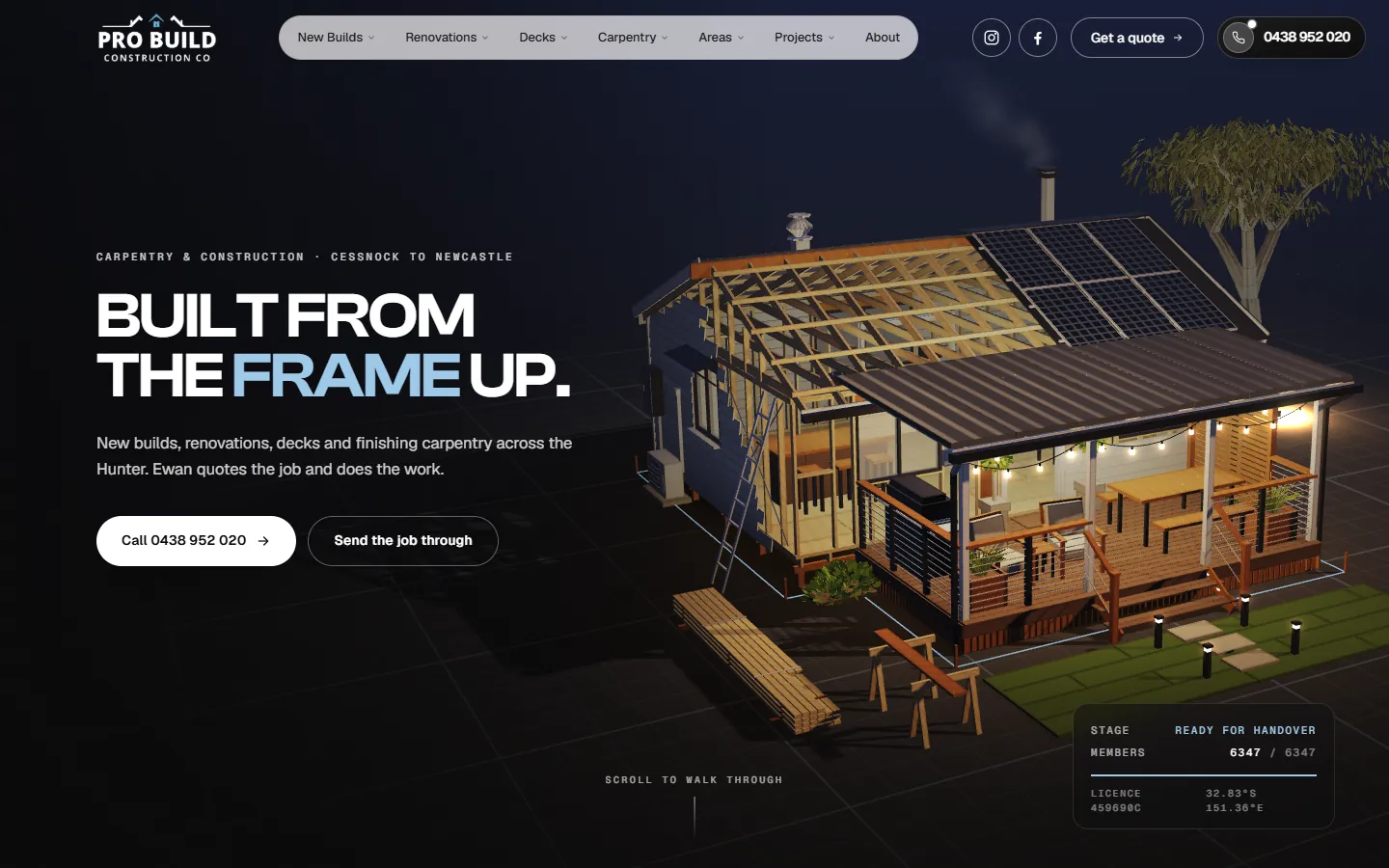 Carpentry and construction Probuild Construction Co Cessnock, NSW
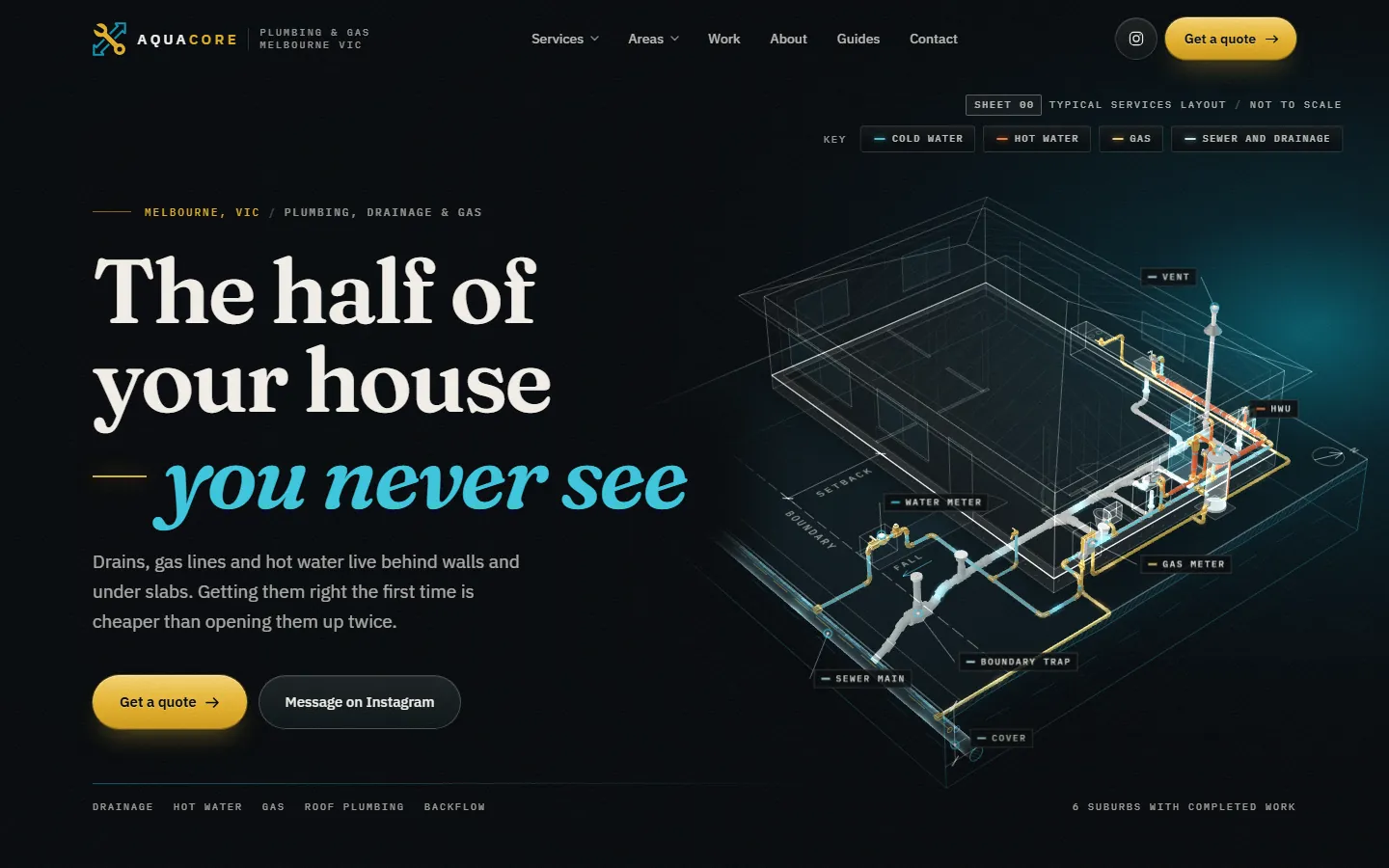 Plumbing AquaCore Plumbing Melbourne, VIC
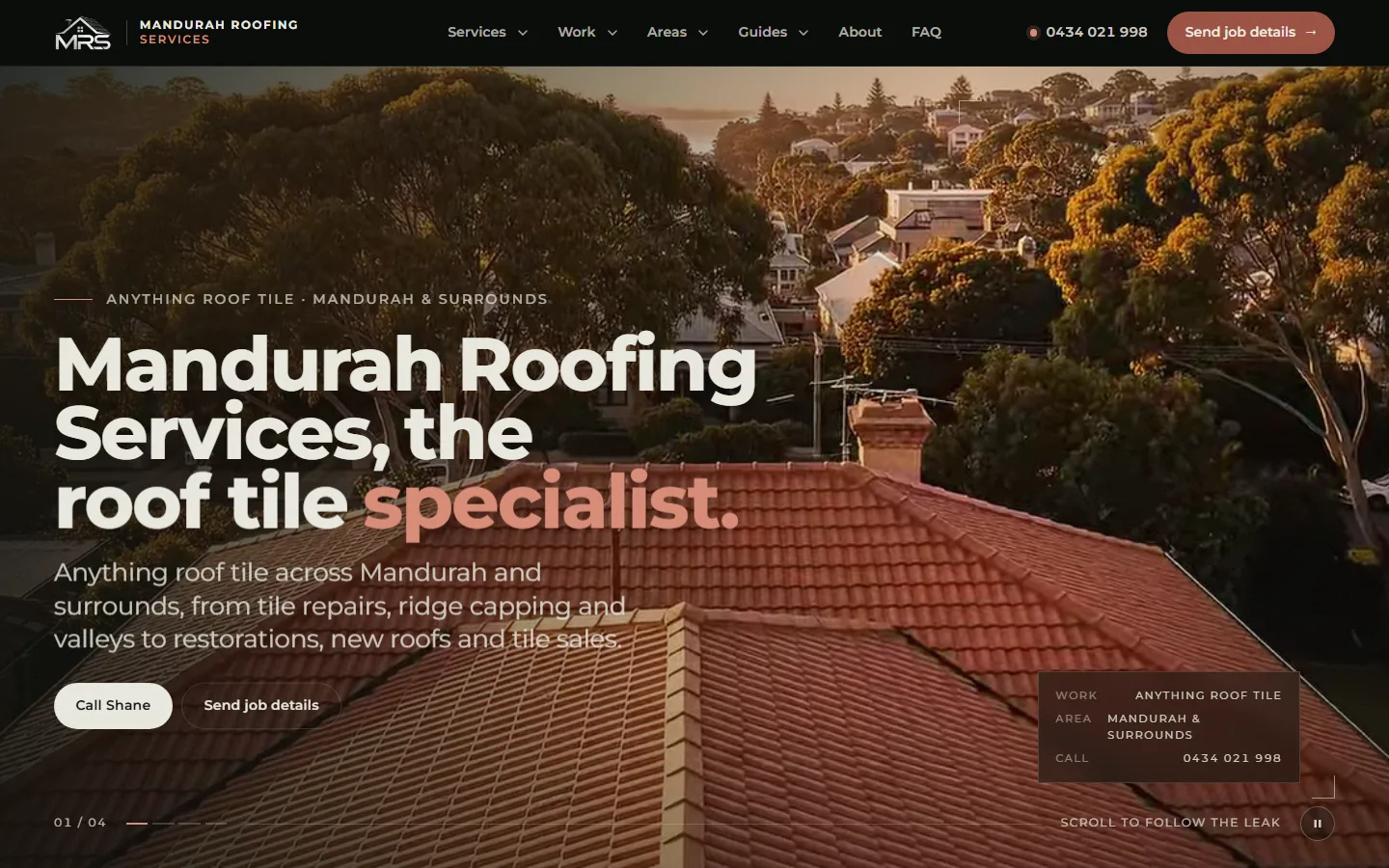 Roof tile repairs and restorations Mandurah Roofing Services Mandurah, WA
// the numbers
Checked before launch, measured against an agreed baseline.
Mobile, accessibility and technical search checks recorded before launch
/ Launch QA
Agreed enquiry events and available search data reported against the baseline
/ Client reporting
// prices and terms
What a website for accountants costs.
- Website build
- A$500 to A$1,000, quoted in writing for the pages and integrations the business needs. A Premium build for a bigger site starts at A$1,000. What Premium covers.
- Hosting and edits
- A$97 a month covers hosting, security, backups and unlimited edits. What website maintenance covers.
- SEO and Google Business Profile
- From A$197 a month, adding Business Profile work, Search Console, directory listings, review requests and a monthly report. What the SEO plan covers.
A quote-scoped one-off build is available without ongoing services, which are quoted separately. The client owns the website, content, domain and source code. Optional ongoing services are month-to-month with no minimum term. The client may cancel at any time, effective at the end of the current paid month. Full pricing and terms.
// straight answers
What accountants and bookkeepers ask before a quote.
- What pages should an accounting firm website have?
- A homepage that says who the firm works for and where, a page for each kind of client it takes on, a fees page that explains how work is priced, team profiles with each practitioner's registration and qualifications, and one clear way to book. Specialist work, such as self-managed super funds, gets its own page only if the firm really does it.
- Should an accountant put the tax agent registration number on the website?
- Yes. A registration line in the footer, with the number linked to the firm's own entry on the TPB Register, is what a careful client looks for. If the firm uses the Tax Practitioners Board's registered symbol, its terms say the number goes with it, and the Code of Professional Conduct asks registered agents to tell clients about the Register and how to search it, with a public website named as one way to do that. The guide to the tax agent registration number on a website shows where each item goes.
- Should an accountant show prices on the website?
- Only prices the firm can stand behind. A simple individual return can carry a fixed fee. Business and company work is usually quoted, so the useful page explains how the quote is worked out and what moves it, rather than printing a rate that will not hold.
- Is a template accounting website good enough?
- It can be, if the firm has time to rewrite the shared pages in its own words, add its own clients' questions and keep the details current. Template packages are usually paid for every year the site runs on them. A Kovus build is quoted once, in writing, at A$500 to A$1,000, and the firm owns the website, content, domain and source code.
- Can Kovus build a website for an accounting firm outside Perth?
- Yes. Kovus works with businesses Australia-wide by phone and video, with on-site meetings across the Perth metro area. Every build is scoped and quoted in writing.
- How much does a website for accountants cost?
- A standard accounting build costs A$500 to A$1,000, quoted in writing with a page per client type, such as sole traders, small companies and families with an investment property, and a page that explains how your fees work. A Premium build, for a bigger site built to a higher finish, starts at A$1,000. Ongoing work is optional: A$97 a month covers hosting, security, backups and unlimited edits, and from A$197 a month adds SEO and Google Business Profile work.
- Who owns the firm's website?
- The firm does. The client owns the website, content, domain and source code from launch. That includes the client-type pages, the fee page and the registration details shown on the site. The monthly plans are month to month with no minimum term, and cancelling takes effect at the end of the current paid month.
- Will the site rank for accountant searches in our area?
- No quote includes a ranking, because Google decides that. The build gives each client type a page, puts the firm's registration where clients check it, and covers the structured data and mobile speed search engines read. The SEO plan then works on the Business Profile, Search Console and directory listings each month, with a report on what changed.
// the framework
Scope the client types first, then the fees and the booking.
An accounting-specific Kovus install, organised around the clients the firm takes on rather than a template's list of services. How the five scoped areas work.
It is the build behind every Kovus site, scoped here to accountants. The other fields are on websites for professional services.
// practical guides
Field guides for accounting websites
- Marketing for Accountants in Australia: What to Do FirstMarketing for accountants and bookkeepers in Australia, in order: the TPB Register, Google profile, service and fee pages, reviews, referrals and email.
- Tax Agent Registration Number: What to Show on Your WebsiteWhere a tax or BAS agent's registration number, the TPB's registered symbol and a Register link go on an accounting website, and how to keep them current.
// built from Perth
A Joondalup sole trader is not a Subiaco company group.
Kovus is based in Perth and builds for firms Australia-wide. How search splits across the Perth metro is covered on Web Design Perth.
Scope an accounting site that shows who you work for.
Send the client types you work with and how you set your fees. Josh comes back with a written quote for the pages to match.
Or call Josh on 0423 155 979 or email josh@kovus.dev.