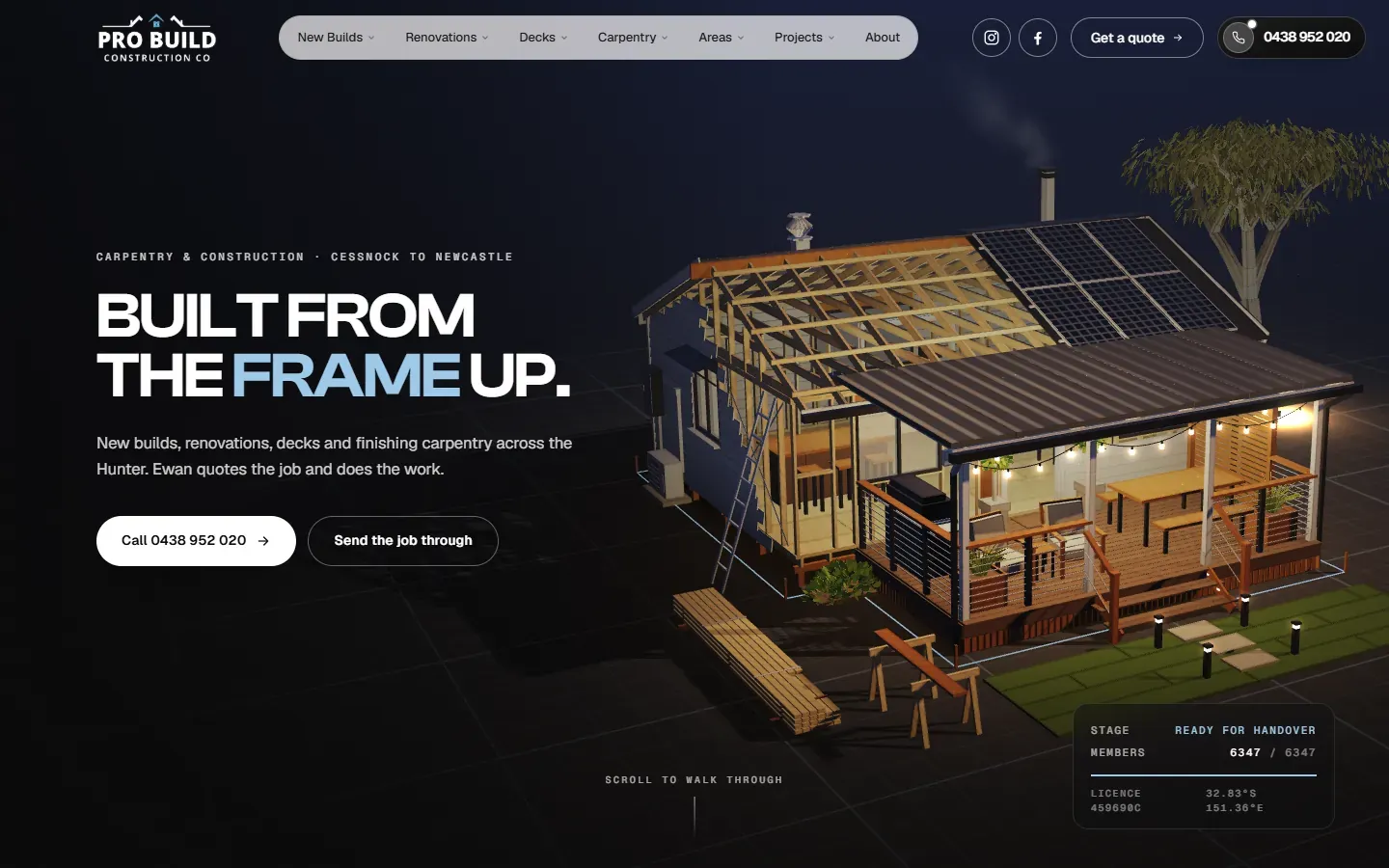
A carpentry business is often three trades under one ABN: framing for builders, joinery for homeowners who want something made to measure, and general work such as decks, pergolas and extensions. Each of those buyers checks different things before they pick up the phone. This guide covers what a carpentry website needs to show each of them: the proof, the compliance details, the pages and the path to a quote.
If you would rather hand the build over, I do carpenter website design for carpentry businesses, from A$500 and quoted in writing. It is the carpentry side of the websites for tradies Kovus builds.
Where carpentry work comes from
- Framing work usually comes from builders and developers. They want the ABN, the insurance and the standards the work is done to before they look at a single photo.
- Joinery work comes from homeowners, designers and builders comparing finish. They want to see finished pieces before they talk about price.
- General carpentry, such as decks, pergolas, extensions and second-fix, comes from local homeowners searching for the job and their suburb, often on a phone.
- A site that leads with the lane the business actually works in, and says so on the first screen, gives each of these buyers less to work out.
The problem: most carpentry websites read like a handyman flyer
A typical carpentry website is a stock photo of someone in a tool belt, a flat “Our Services” grid of six icons, and a contact form. That treats framing a house, building a custom kitchen, and adding a deck as the same kind of job, when they’re sold to completely different buyers with completely different urgency and budget. The site that doesn’t pick a lane ends up looking generic to all three.
Why carpentry sites read as commodity work
- A generic services grid instead of an editorial layout. Carpentry is a craft trade, and a 3-column icon grid reads as commodity, not craft, exactly the wrong signal for a builder or homeowner comparing quotes.
- No compliance proof for structural work. A builder checking whether to hand over a framing job wants AS 1684 and NCC compliance stated plainly, not implied.
- One site trying to be all three sub-niches at once. A framing-for-builders page sitting next to a bespoke-kitchen gallery next to a deck-repair form confuses every visitor about what this business actually specialises in.
- Missing or vague trust signals. ABN, public liability, years trading, project count: these are what a builder or a homeowner about to remove a load-bearing wall checks first, and they’re often buried or absent.
- Business details that search tools can’t read. If the trading name, the trade, the area and the contact details only sit in a logo or a photo, Google and AI search tools have little to go on when someone looks for a carpenter.
Building a carpentry site around one lane
01. Suburb pages for homeowners, project pages for builders
For generalist and joinery carpentry, a page for each suburb where there is work to show, written around the local houses and the jobs done there, not a template with the suburb swapped in. For framing businesses working with builders and developers, project case-study pages instead, since that buyer doesn’t search by suburb. Plus a complete Google Business Profile with the services and the areas the business really covers.
02. An editorial layout with AS 1684 and NCC proof
An editorial 2-up services layout, alternating photo and copy per service, instead of a generic icon grid, the pattern the top carpentry and joinery businesses actually use. ABN, AS 1684 and NCC compliance, public liability, and years trading or project count stated up front. A clear process, on-site measure to written quote, so there are no surprises once the job starts. Short forms, and pages that stay quick on mobile data.
03. Business details and framing and renovation content
The same business name, description and contact details on the site, Google, Facebook, Instagram and directories, plus structured data that states the business type, the area and the services in a form search engines read. Pair it with real content around framing timelines and renovation costs, so ChatGPT, Perplexity, Claude and Google’s AI features have accurate facts to work from when someone asks for a carpenter. Whether any AI tool mentions the business is up to each platform.
04. Framing, load-bearing wall and kitchen answers
A blog aimed at what customers and builders actually type. “How long does home framing take”, “load-bearing wall removal, do I need an engineer”, “custom kitchen cost in [city]”, “deck vs pergola, what’s the difference”. Each post answers the question fully and captures the search before a competitor does.
05. Telling homeowner enquiries from builder enquiries
Call and form tracking tied to which service or project page generated the enquiry, whether that’s a homeowner or a builder. A monthly check of where the business sits in Google’s map results for the suburbs that have pages, and of whether ChatGPT, Perplexity and Google’s AI answers mention it.
Comparing on capability, not only on price
A framing contract or a custom joinery job is a five-figure decision, and the buyer, whether it’s a builder checking compliance or a homeowner about to remove a wall, is looking for reasons to trust the person before they trust the price. A generic handyman-flyer site gives them nothing to go on except the quote number, so the cheapest bid wins by default.
Show the compliance proof, the real trade lane the business actually operates in, and a services section that reads as craft rather than commodity, and the same visitor starts comparing on capability instead of price alone. One carpenter able to take a job from frame to finish is also a genuine differentiator worth stating plainly, it means one accountable tradesperson instead of two handoffs.
No website can promise a set number of jobs. The result moves with the work you take on, the photos you have and how quickly you follow up a quote.
Tell me about the business
Tell me which of the three lanes the business works in, the jobs you want more of and the suburbs you cover. I’ll set out the pages, the proof and the quote form that suit them, with the price in writing. The carpenter website design page shows what the build includes.
Frequently asked questions
Should a carpentry website mention AS 1684?
Yes, if the business does structural or framing work. AS 1684 is the Australian Timber Framing Code, and stating that wall frames, subfloors, beams, and roof trusses are set out to it, alongside the National Construction Code, is the compliance signal that a builder or engineer-conscious homeowner looks for before handing over a structural job.
Why do carpentry sites need three different shapes instead of one template?
Framing is largely B2B work for builders and developers, where the buyer checks ABN and compliance before anything else. Joinery is premium interior work sold on craft and finish. Generalist carpentry, decks, extensions, second-fix, is owner-operator work sold on trust and photos. Treating all three the same way, usually as a generic services grid, undersells whichever one the business actually specialises in.
Does a carpentry website need suburb pages?
For generalist and joinery carpentry, yes, fifteen to twenty-five suburb pages is typical, since those are consumer searches. Framing is different: builders and developers don't search by suburb, so framing-focused sites are usually better served by project case-study pages for repeat commercial clients instead.
What trust signals matter most for a carpentry business?
ABN or ACN registration, AS 1684 and NCC compliance, public liability insurance, and years trading or project count, roughly in that order. Master Builders membership is a strong additional signal where it's genuinely held. None of it should be claimed unless it's real and verifiable.
Is quote-only pricing normal for carpentry?
Yes. Scope varies too much between a single door rehung and a full home extension for an hourly or per-square-metre rate card to be honest. The trust signal isn't a price table, it's a clear, written, itemised quote after the on-site measure, with no surprises once the job starts.
What should a carpentry services section look like instead of a generic icon grid?
The top Australian carpentry and joinery businesses use an editorial 2-up layout, alternating image and copy blocks per service, rather than a flat 3-column card grid with six icons. It reads as craft rather than a commodity list, and it gives each service room to actually explain the work.
Can one carpenter realistically do both structural framing and finishing work?
Yes, and it's a genuine selling point when true. A carpenter who can take a job from the structural frame through to the finishing trim means the client deals with one accountable tradesperson for the whole build, instead of coordinating a framer and a separate finishing carpenter.